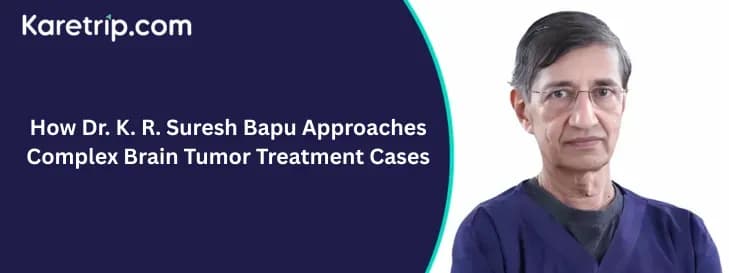

Not every neurosurgeon approaches a complex brain tumor the same way. The difference between a surgeon who removes what is safely accessible and one who safely removes what appears inaccessible is rarely visible to a patient reading a hospital website. It lives in the technique, the training behind it, and the institutional depth of experience that allows a surgeon to make confident intraoperative decisions when anatomy does not follow the textbook. Dr. K. R. Suresh Bapu, Director and Senior Consultant Neurosurgeon at the Institute of Neurosciences, SIMS Hospital, Chennai, represents one of the most accomplished clinical profiles in Indian neurosurgery. With over 48 years of active surgical experience, pioneering training under Professor Gazi Yasargil of Zurich, the man widely regarded as the father of modern microneurosurgery, and a career that has included firsts in South Tamil Nadu that changed the trajectory of neurosurgical care in the region, Dr. Suresh Bapu's approach to
complex brain tumor treatment cases is the product of a career that very few surgeons anywhere in the world can match in depth.
Who Dr. K. R. Suresh Bapu Is: The Foundation Behind the Approach
Understanding how Dr. Suresh Bapu approaches complex brain tumor treatment cases requires first understanding the specific training and career milestones that shaped his surgical philosophy and technique.
Qualifications and Training
Dr. Suresh Bapu completed his MBBS and MS from Madurai Medical College, Tamil Nadu. He then pursued fellowship-level training in MicroNeurosurgery under Professor Gazi Yasargil at the University Hospital of Zurich in 1981 to 1982, making him one of the first few neurosurgeons in India to receive direct training under Yasargil, whose techniques for microsurgical brain surgery are the foundation on which modern neurosurgery globally is built. Dr. Suresh Bapu has additionally undergone neurosurgical training programmes in the USA and Japan, covering advanced endoscopic and skull base surgical techniques.
This combination of foundational training directly under the originator of modern microneurosurgery, followed by multi-country exposure to evolving subspecialty techniques, defines the depth of his technical repertoire.
Career Milestones That Established His Expertise
Here is the information broken down into clean, scannable, and highly professional bullet points.
Academic Leadership & Training
-
Professor of Neurosurgery (1982–2006): Served as Assistant Professor and Professor at Government Medical Colleges in Tamil Nadu, training generations of future neurosurgeons.
-
National & International Examiner: Evaluated advanced MCh and DNB Neurosurgery candidates at prestigious institutions, including CMC Vellore, Nizam's Institute (Hyderabad), MGR Medical University, and Tribhuvan University (Nepal).
-
MGR Medical University Best Teacher Award: Honored with this prestigious award for his outstanding contributions to medical education.
Surgical Milestones & Innovation
-
Microneurosurgery Pioneer: Credited with establishing microneurosurgery as a practiced discipline across South Tamil Nadu, making advanced care widely accessible.
-
Surgical First (1984): Became the first surgeon in South Tamil Nadu to perform a STA-MCA anastomosis, a highly complex cerebrovascular procedure requiring exceptional microvascular precision.
Elite Clinical Appointments
-
SIMS Hospital, Vadapalani (2014–Present): Currently serves as the Director and Senior Consultant Neurosurgeon at the Institute of Neurosciences, maintaining an active surgical practice.
-
Apollo Hospitals, Chennai (1998–2014): Served as Senior Consultant Neurosurgeon for over 15 years.
Professional Memberships
Maintains active engagement with evolving global medical standards through memberships in the Indian Medical Association (IMA), Neurological Society of India (NSI), and the Neuro Spinal Surgeons Association India (NSSA).
Clinical Philosophy
Dr. Suresh Bapu is known to offer patient-centric management as a defining feature of his practice, alongside clinical precision. Patient reviews consistently describe his availability, his directness in explaining complex diagnoses and surgical options, and his willingness to invest time with patients and their families before and after surgery. Patients from across India and internationally have described him as someone whose calm confidence in the theatre carries through to his interactions with families under significant emotional pressure.
The Specific Brain Tumor Cases Dr. Suresh Bapu Manages
Dr. Suresh Bapu's complex brain tumor treatment practice covers a specific and demanding set of tumour types and locations that require the intersection of microsurgical, endoscopic, and functional neurosurgical expertise.
Gliomas in Eloquent Brain Regions
Gliomas, the most common primary malignant brain tumours, present their greatest surgical challenge when they arise in or near eloquent brain areas, those regions responsible for speech, language, motor function, and other critical faculties that must be preserved during surgery. Glioma surgery in eloquent brain regions remains one of the greatest challenges in neurosurgery, demanding a balance between oncologic control and preservation of function.
Dr. Suresh Bapu performs surgery of low-grade glioma in the eloquent brain with neuronavigation and neurophysiological monitoring, including awake procedures. This three-part technical combination, neuronavigation, neurophysiological monitoring, and awake craniotomy, represents the highest standard available for glioma surgery in functionally sensitive brain regions.
Skull Base Tumours
Skull base tumours, those arising at the floor of the cranium where the brain interfaces with the structures of the face, sinuses, and neck, are among the most technically demanding neurosurgical cases. Access is constrained, proximity to cranial nerves and major vascular structures is intimate, and the tolerance for error is minimal. Dr. Suresh Bapu specialises in total excision of cerebellopontine angle (CPA) tumours with preservation of the facial nerve, and performs endonasal endoscopic surgery for pituitary tumours, craniopharyngiomas, and skull base tumours, as well as minimal access skull base surgery for cerebellopontine angle schwannomas.
The cerebellopontine angle is the space between the cerebellum and the brainstem, and schwannomas arising from the acoustic nerve in this location (commonly called acoustic neuromas or vestibular schwannomas) are one of the most common skull base tumours encountered internationally.
Total excision while preserving the facial nerve, which runs in close proximity to these tumours, requires microneurosurgical precision and the kind of three-dimensional anatomical familiarity that only comes with high-volume experience.
Pituitary Tumours and Craniopharyngiomas
Pituitary tumours and craniopharyngiomas are treated by Dr. Suresh Bapu through the endonasal endoscopic route where appropriate, accessing the tumour through the nasal cavity and sphenoid sinus without any craniotomy. This approach is now the gold standard for most pituitary adenomas and for craniopharyngiomas with primarily suprasellar extension.
The key advantage of the endonasal endoscopic approach for pituitary surgery is the avoidance of brain retraction and the direct line of sight to the tumour that the endoscope provides through a route that leaves no external incisions.
Recovery is meaningfully faster than with traditional approaches, and hospital stays are shorter, which is particularly relevant for international patients who must plan their return travel.


The Technical Approaches That Define His Practice
Here is the breakdown of Dr. Suresh Bapu's core surgical techniques into clean, scannable, and highly professional sections:
Advanced Microneurosurgery
-
The Foundation: Trained directly under the pioneer Professor Yasargil, forming the basis for every complex brain and spinal cord tumor surgery he performs.
-
Microscopic Precision: Utilizes advanced operating microscopes and miniaturized instruments to clearly distinguish tumor boundaries from healthy brain tissue.
-
Tissue Preservation: High-magnification clarity allows for the maximal removal (resection) of tumors while safely protecting adjacent, critical blood vessels.
Awake Craniotomy & Brain Mapping
-
Real-Time Mapping: Performed while the patient is safely sedated but conscious during a critical phase, allowing them to speak, count, or move limbs on cue.
-
Eloquent Cortex Protection: Identifies the precise boundaries of speech and motor functions in the brain, ensuring the tumor is removed without harming vital centers.
-
Three-Way Safety Framework: Combines the awake phase with two advanced technologies:
-
Neuronavigation: Computer-assisted 3D GPS tracking of surgical tools against the patient’s MRI in real time.
-
Neurophysiological Monitoring: Continuous electrical tracking of motor and sensory pathways to provide instant early warning signals.
Minimally Invasive Endoscopic Neurosurgery
-
Natural Corridors: Accesses deep brain structures through natural pathways (like the nose) or tiny incisions, eliminating the brain tissue retraction required in traditional open surgery.
-
Intraventricular Surgery: Navigates directly into the brain's fluid spaces via a small burr hole to cleanly remove complex blockages like colloid cysts, leading to a faster recovery.
-
Skull Base Expertise: Regularly treats pituitary adenomas and craniopharyngiomas endonasally (through the nose) to protect the frontal and temporal lobes.
-
Advanced Vascular Safety: Employs Intraoperative Microvascular Doppler (MVD) to track blood vessels next to tumors, heavily reducing the risk of vascular injury.
Cerebrovascular & Functional Specializations
-
Vascular Reconstruction: Highly experienced in microsurgery for complex intracranial aneurysms and arteriovenous malformations (AVMs).
-
Bypass Expertise: Holds decades of experience in STA-MCA anastomosis (a demanding microvascular bypass procedure used when major vessels are compromised by tumors).
-
Nerve Decompression (MVD): Performs Microvascular Decompression for conditions like trigeminal neuralgia and hemifacial spasms, separating compressing blood vessels from nerves to provide permanent pain relief without damaging the nerve itself.
-
Advanced Pain Management: Specialized in DREZ lesioning for severe, chronic pain management.
Why International Patients Choose Dr. Suresh Bapu Through Karetrip
International patients from Nigeria, Bangladesh, Kenya, the UAE, the UK, and across South Asia travel to Chennai specifically to be managed by Dr. Suresh Bapu for complex brain tumour cases. The reasons converge on four specific realities.
Rare Combination of Microscopic and Endoscopic Expertise
Most neurosurgeons develop either strong microsurgical technique or strong endoscopic technique. Dr. Suresh Bapu's practice encompasses both at a high level, which matters specifically because complex brain tumour cases do not always present in a format where one approach alone is sufficient. A skull base tumour may require an endoscopic endonasal corridor combined with a microsurgical lateral approach for full removal.
A glioma near the ventricle may require an endoscopic intraventricular view alongside microscopic cortical resection. The surgeon who can apply both toolsets to a single case offers a fundamentally different level of access to complex anatomy.
Awake Craniotomy Availability for Eloquent Brain Tumours
Awake craniotomy is not available everywhere. It requires a neurosurgeon with the specific experience to manage the intraoperative communication demands of a conscious patient during brain surgery, an anaesthetic team practised in the asleep-awake-asleep protocol, a neurophysiology team capable of continuous monitoring, and a neuronavigation system calibrated for real-time intraoperative guidance.
Dr. Suresh Bapu's practice at SIMS Hospital brings all of these elements together, making it accessible to international patients who cannot access this level of service in their home country.
Cost That Is Genuinely Accessible
Complex brain tumour surgery including awake craniotomy, skull base surgery, and endonasal endoscopic pituitary surgery in the USA or UK carries procedural costs in the range of USD 50,000 to USD 150,000 or higher, depending on complexity and duration of hospital stay.
The same procedures performed by a surgeon of equivalent or superior technical credentials at SIMS Hospital in Chennai cost a fraction of these figures, with overall savings of 60 to 80 percent typical for international patients accessing neurosurgical care in India.
The Trust That Comes From a Proven Track Record
Patient testimonials for Dr. Suresh Bapu span decades and cross borders. Patients who came from Saudi Arabia in the 1990s. A son whose father was saved from trigeminal neuralgia after eight years of suffering.
A family whose son survived a critical brain surgery in 2013 that was described as life-saving. These are not marketing claims. They are the documented experiences of patients who faced some of the most difficult neurological decisions of their lives and found their outcomes transformed by care at this level.
Why Choose Karetrip for Your Care with Dr. Suresh Bapu?
When facing a complex brain tumor diagnosis, a border shouldn't stand between you and world-class surgical expertise. While anyone can attempt to call a hospital, international families choose Karetrip because we eliminate the critical administrative and logistical friction points that delay lifesaving care.
Here is exactly how Karetrip acts as your dedicated medical advocate before, during, and after your treatment in India:
-
Pre-Travel Case Verification: You don't need to fly to India just to see if you are a candidate for surgery. Our team ensures Dr. Suresh Bapu reviews your advanced imaging, scans, and biopsy reports before you ever board a plane, giving your family immediate clarity.
-
Priority Surgical Scheduling: Securing a slot with a director-level neurosurgeon can normally take weeks. Karetrip fast-tracks your consultation and pre-assessment scheduling at SIMS Hospital, Chennai, minimizing the time between diagnosis and treatment.
-
Expedited Medical Visa Support: Standard tourist visas are often delayed or rejected for medical travel. We provide the official institutional documentation required by the government to help secure your medical visas quickly and legally.
-
A Secure Logistical Shelter: We organize specialized, patient-friendly accommodations near SIMS Hospital in Vadapalani, ensuring your family has a safe, comfortable, and low-stress environment for pre-op waiting and post-op recovery.
-
Seamless Continuity of Care: Your treatment doesn't end when you leave the operating theater. We design a comprehensive discharge and transition plan, ensuring your local doctors at home receive the exact neuro-oncological and rehabilitation protocols needed to manage your recovery safely.
-
Take the First Step Safely: You don't have to navigate this stressful journey alone. Chat with our Medical Care Assistant, RUA, right now to get your medical reports organized and securely forwarded to Dr. Suresh Bapu's team for an expert case review.
Medical Disclaimer
This article is compiled for international healthcare awareness and general educational reference regarding complex neurosurgical interventions. It does not replace a personalized clinical consultation, diagnostic testing, or official evaluation by a licensed neurosurgeon or neurological specialist. Individual surgical candidacy, approach selection—such as awake craniotomy or endoscopic endonasal resection—and long-term functional recovery outcomes vary significantly based on unique tumor pathology, precise tumor margins, proximity to eloquent brain regions, and the patient's baseline physiological health. Always consult a qualified neurosurgeon or emergency medical team before making cross-border medical travel decisions or altering an active neurological care plan.