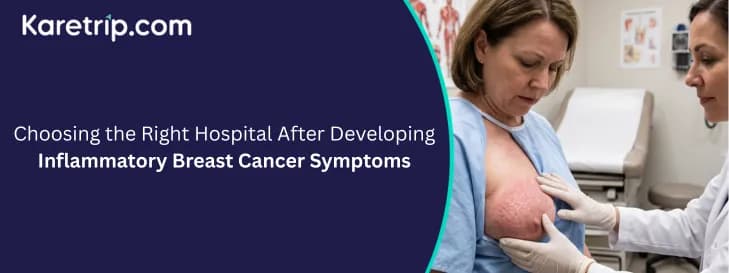

Inflammatory breast cancer moves fast. Unlike most breast cancers, which develop slowly over months or years, inflammatory breast cancer can change within weeks progressing from a rash or warm patch to significant breast swelling, skin thickening, and systemic spread if not diagnosed and treated promptly. It accounts for only one to five percent of all breast cancer cases in the United States, yet it accounts for approximately ten percent of US breast cancer deaths, which tells you exactly how much its outcome depends on the speed and quality of the response. The first and most important decision after developing inflammatory breast cancer symptoms is not which treatment to choose. It is which hospital to choose. This guide explains the symptoms that distinguish IBC from other breast conditions, what an accurate diagnosis requires, what the treatment protocol involves, and the specific criteria that define a hospital capable of delivering it correctly.
Recognising Inflammatory Breast Cancer Symptoms
IBC is frequently misdiagnosed as mastitis or a breast infection in its early stages, because the symptoms overlap. This misdiagnosis delays the oncological evaluation that IBC requires. Knowing the distinguishing features of inflammatory breast cancer symptoms is the first step toward seeking the right care.
The Core Symptoms of IBC
Inflammatory breast cancer symptoms arise when cancer cells block the lymph vessels in the breast skin, causing a characteristic cluster of changes that appear rapidly, typically over weeks rather than months:
-
Skin redness or discolouration covering at least one-third of the breast, appearing red, pink, purple, or bruise-like. The rash may appear suddenly, even overnight.
-
Peau d'orange appearance: the breast skin develops a dimpled or pitted texture resembling the surface of an orange, caused by lymphatic obstruction pulling the skin inward at follicle points.
-
Warmth and swelling of the breast, which is typically heavier and larger than the unaffected side.
-
Skin thickening: the breast skin feels noticeably thicker than the other side.
-
Nipple changes: flattening, retraction, erythema, crusting, or blistering of the nipple.
-
Breast pain or tenderness, which may be persistent rather than cyclical.
-
Itching of the breast skin.
What Makes IBC Different From Mastitis
The most important clinical distinction is antibiotic response. If the breast inflammation does not improve after one week of antibiotic treatment, a breast specialist should be seen immediately. Mastitis improves with antibiotics. IBC does not.
A discretely palpable lump may or may not be present in IBC, which is why it cannot be ruled out simply because no lump is felt. Unlike many other types of breast cancer, IBC does not typically start with a distinct lump or tumour that can be felt or isolated. Relying on the absence of a palpable mass to dismiss IBC is one of the most dangerous diagnostic errors.
Who Is at Higher Risk
IBC tends to occur in younger women than other breast cancers and has a higher incidence in women of African descent. Additional risk factors include:
-
No full-term pregnancies or first pregnancy after age 30
-
Overweight or obesity, which is associated with increased IBC risk
-
Prior personal history of breast cancer
-
Family history of breast cancer
The Diagnostic Pathway After IBC Symptoms Appear
A correct diagnosis of IBC requires a specific sequence of investigations. Not every hospital performs this sequence competently or promptly, which is one of the most important reasons hospital selection matters immediately after symptoms develop.
Step 1: Breast Imaging
All patients with suspected IBC undergo breast imaging as the first formal evaluation step. This includes:
-
Diagnostic mammogram of the affected breast and screening mammogram of the contralateral breast
-
Breast ultrasound, which assesses skin thickening, lymph node involvement, and any underlying mass
-
Breast MRI for extent of disease evaluation and treatment planning
Abnormal screening mammogram is the event that triggers diagnosis in fewer than 10 percent of IBC cases. Most IBC presents clinically, through symptoms, which means the imaging follows clinical suspicion rather than leading to it.
Step 2: Core Needle Biopsy
Definitive diagnosis of IBC requires histological confirmation of invasive carcinoma on core needle biopsy. The biopsy also provides the receptor status, which is essential for treatment planning:
-
ER/PR status (oestrogen and progesterone receptor)
-
HER2 status
-
Ki-67 proliferation index
-
Molecular subtype (Luminal A/B, HER2-enriched, Triple-negative)
IBC is significantly more likely than other breast cancers to be HER2-positive or triple-negative, both of which have specific targeted treatment implications. A hospital that does not routinely perform comprehensive receptor testing on all breast cancer biopsies cannot provide the personalised treatment that IBC requires.
Step 3: Systemic Staging
IBC is staged as at least Stage III at diagnosis. Systemic staging must be performed to exclude or characterise any distant metastases before treatment begins, using:
-
CT chest, abdomen, and pelvis with contrast
-
Bone scan or PET-CT scan
-
Brain MRI in symptomatic or high-risk patients
The IBC Treatment Protocol: Why NCCN-Concordant Trimodal Therapy Matters
The NCCN guidelines for non-metastatic inflammatory breast cancer specify a trimodal treatment approach: neoadjuvant chemotherapy, followed by modified radical mastectomy, followed by adjuvant radiation therapy. This sequence is not optional, and the survival data shows why.
A NCBI-published analysis of 13,733 IBC patients found that only 47.6 percent received NCCN-concordant trimodal therapy. Yet research shows improved five-year and ten-year survival for patients receiving guideline-concordant treatment. The divergence between the survival benefit of guideline-adherent care and the proportion of patients actually receiving it represents one of the most critical hospital selection factors in IBC treatment.
Stage 1: Neoadjuvant Chemotherapy
Chemotherapy is given before surgery to shrink the tumour, assess treatment response, and reduce the risk of systemic spread. Standard neoadjuvant regimens for IBC include anthracycline and taxane-based combinations. HER2-positive IBC adds targeted HER2 therapy (trastuzumab plus pertuzumab) to the chemotherapy backbone. Triple-negative IBC may include immunotherapy (pembrolizumab) or PARP inhibitors for BRCA-mutated cases based on 2025 NCCN guidance.
The pathological complete response (pCR) achieved at surgery after neoadjuvant chemotherapy is one of the most important prognostic factors in IBC.
Stage 2: Modified Radical Mastectomy
Following neoadjuvant chemotherapy, modified radical mastectomy with axillary lymph node dissection is performed. Breast-conserving surgery is not appropriate for IBC, even if the tumour responds dramatically to chemotherapy. The NCCN guidelines are explicit on this point. Sentinel lymph node biopsy alone is not sufficient for IBC — full axillary dissection is the standard.
Delayed breast reconstruction, rather than immediate reconstruction, is recommended to avoid compromising the subsequent radiation field.
Stage 3: Adjuvant Radiation Therapy
Post-mastectomy radiation therapy to the chest wall and regional lymph nodes is mandatory in IBC, regardless of chemotherapy response. Radiation is not optional even when a complete pathological response has been achieved, because IBC's pattern of dermal lymphatic involvement makes local recurrence risk higher than in non-IBC even after complete systemic response.
Additional Systemic Therapies After Surgery
-
Hormone receptor-positive IBC: endocrine therapy for five to ten years
-
HER2-positive IBC: adjuvant trastuzumab emtansine (T-DM1) if residual disease is present after surgery, or completion of one year of pertuzumab plus trastuzumab if pCR was achieved
-
Triple-negative IBC: adjuvant capecitabine if residual disease; pembrolizumab if immunotherapy was part of neoadjuvant treatment


Five Criteria for Choosing the Right Hospital for IBC
The hospital you choose for IBC treatment must meet specific institutional criteria that directly affect whether you receive NCCN-concordant trimodal therapy.
Criterion 1: Dedicated Breast Oncology Programme
IBC must be managed by a dedicated breast oncology team, not a general oncology department that occasionally treats breast cancer. This means a specialist breast medical oncologist, breast surgical oncologist, and radiation oncologist who all have specific IBC experience. The most accurate inflammatory breast cancer diagnosis and personalised treatment by experts who specialise in IBC can make an important difference.
Criterion 2: Multidisciplinary Tumour Board
Every IBC case must be reviewed by a tumour board before treatment begins, confirming the staging, the neoadjuvant regimen, the surgical plan, and the radiation strategy in a single coordinated clinical discussion. A hospital that treats IBC without tumour board review is making isolated decisions on a cancer that requires integrated multimodal planning.
Criterion 3: HER2-Targeted and Immunotherapy Drug Access
IBC patients are more likely to have HER2-positive or triple-negative disease than non-IBC breast cancer patients. A treating hospital must have trastuzumab, pertuzumab, T-DM1, and pembrolizumab reliably available. These agents are not universally accessible in all healthcare environments, and confirming drug availability before treatment starts is a practical necessity for international patients.
Criterion 4: Radiation Oncology With Post-Mastectomy Capability
Post-mastectomy radiation to the chest wall and regional nodes requires specific technical capability including CT-based treatment planning, a modern linear accelerator, and radiation oncologist experience with post-mastectomy fields. Not all hospitals with chemotherapy services have radiation oncology capability of this standard.
Criterion 5: Speed of Access to Diagnosis and Treatment
IBC is time-sensitive in a way that most solid tumours are not. A hospital that cannot perform biopsy within days of presentation, provide receptor results within one week, and begin chemotherapy within two to three weeks of diagnosis is not the right hospital for IBC. Access speed is as important as technical capability.
IBC Treatment in India: What International Patients Access
India's leading NABH and JCI-accredited oncology centres offer NCCN-concordant trimodal IBC treatment including anthracycline-taxane neoadjuvant chemotherapy, HER2-targeted therapy, immunotherapy where indicated, modified radical mastectomy with axillary dissection, and post-mastectomy radiation — all within a dedicated breast oncology programme and multidisciplinary tumour board structure.
For international patients from Nigeria, Bangladesh, Kenya, the UAE, and the UK, the cost of IBC treatment in India is typically 60 to 70 percent lower than in the USA or UK. A full course of neoadjuvant chemotherapy, surgery, and adjuvant radiation in India costs approximately Rs. 8,00,000 to Rs. 20,00,000 (USD 9,600 to USD 24,000) depending on the specific drugs and hospital tier, compared to USD 80,000 to USD 200,000 in the USA for the same treatment sequence.
Speed of access at India's private cancer hospitals is particularly important for IBC. Most leading oncology centres can schedule biopsy within one to two days of arrival, provide receptor results within five to seven days, and begin neoadjuvant chemotherapy within two weeks of confirmed diagnosis — timelines that are clinically appropriate for a cancer that progresses over weeks.
Top Oncology Networks and Cancer Hospitals in India
International patients seeking rapid, NCCN-concordant care for time-sensitive conditions like inflammatory breast cancer can access several premier JCI and NABH-accredited oncology hubs across India. These major networks provide full access to cutting-edge diagnostic pathways, rapid core-needle testing, molecular profiling, and multidisciplinary tumor boards.
Apollo Cancer Centres (APCC)
The Apollo network features some of the most advanced solid-tumor facilities in South Asia.
Key Centers: Apollo Proton Cancer Centre (Chennai), Indraprastha Apollo Hospital (New Delhi), and Apollo Specialty Cancer Hospital (Greams Road, Chennai).
Clinical Strengths: APCC operates via specialized Organ-Specific Cancer Management Teams, meaning breast cancer subspecialists directly triage cases. They offer elite precision diagnostics, including next-generation sequencing (NGS), along with standard-of-care immunotherapy and advanced linear accelerators (LINAC) for complex post-mastectomy chest wall radiation.
Max Institute of Cancer Care (MICC)
Max Healthcare operates a highly integrated, multi-campus oncology framework across North India.
Key Centers: Max Super Speciality Hospital (Saket, New Delhi) and BLK-Max Super Speciality Hospital (New Delhi).
Clinical Strengths: The Saket flagship is JCI-accredited and hosts dedicated Disease Management Groups (DMGs) focused specifically on aggressive breast cancers. The network features advanced radiosurgery and targeted oncology divisions, ensuring that complex systemic staging (PET-CT, Contrast CTs) and neoadjuvant infusions can be initiated within days of a patient's arrival.
Fortis Healthcare & Medanta Network
These quaternary private healthcare institutions in the Delhi National Capital Region (NCR) offer premium cancer care infrastructure.
Key Centers: Fortis Memorial Research Institute (FMRI, Gurugram) and Medanta – The Medicity (Gurugram).
Clinical Strengths: Both institutions house deep, dedicated breast oncoplastic surgery teams and complex radiation setups. Their multidisciplinary tumor boards meet daily, facilitating immediate cross-specialty alignment between medical, surgical, and radiation oncologists to fast-track trimodal therapy protocols.
Healthcare Global Enterprises (HCG) & Regional Excellence Hubs
As one of India's largest specialized, cancer-only hospital networks, HCG offers dedicated focus outside of general tertiary hospital distractions.
Key Centers: HCG Cancer Centre Bangalore & Mumbai and regional centers of excellence like Meitra Hospital (Kozhikode, Kerala—JCI accredited).
Clinical Strengths: These hubs focus heavily on precision medicine and genomic profiling. By running an on-site, fully accredited transplant immunology and pathology ecosystem, they drastically cut down the time required to calculate HER2 status and Ki-67 indexes, allowing patients to start targeted neoadjuvant regimens immediately.
How Karetrip Connects International IBC Patients to the Right Oncology Centre
Speed matters more for IBC than for almost any other solid tumour. Karetrip reviews each patient's imaging and biopsy reports before recommending an oncology centre in India, confirming that the proposed hospital has a dedicated breast oncology team, tumour board review for every IBC case, HER2-targeted therapy availability, and post-mastectomy radiation capability. Patients with IBC are triaged as priority referrals.
From pre-arrival record review and medical visa coordination, through accommodation near the treating hospital, coordination with the oncology team during treatment, and discharge documentation for continued adjuvant therapy management at home, Karetrip supports every stage of the international IBC patient journey.
Chat with our Medical care assistant, RUA, for quick guidance and support and take the first step toward reaching an oncology centre equipped to deliver the full NCCN-concordant treatment that inflammatory breast cancer requires.
Medical Disclaimer
This article is for informational purposes only and does not constitute medical advice. If you notice any changes in your breast, seek medical attention immediately. Inflammatory breast cancer requires urgent specialist evaluation — do not delay care.