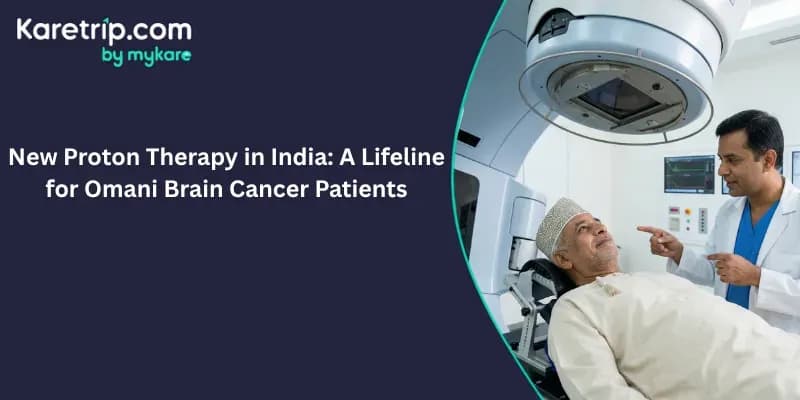

A brain cancer diagnosis creates an immediate, overwhelming shift in reality for any family. In cities across Oman, from Muscat and Nizwa to Sur and Salalah, receiving news of a cranial mass initiates an urgent, desperate search for the absolute highest tier of oncological care available globally. The brain is the epicenter of human identity, regulating our memories, personalities, and physical functions. Treating a tumor within this incredibly delicate space demands an intervention that is intensely aggressive toward the cancer, yet exceptionally protective of the surrounding healthy neurons.
For many years, standard radiation was the primary tool available to oncologists, but it carried heavy biological consequences. Today, the entire landscape of neuro-oncology has shifted dramatically. Proton Beam Therapy stands as the absolute pinnacle of precision radiation medicine. While this highly advanced, monumental technology is scarce in many parts of the world, India has built a robust, state-of-the-art infrastructure to deliver it.
For patients in Oman, this means that the most sophisticated cancer-fighting technology on the planet is accessible just a short flight across the Arabian Sea. At karetrip, we serve as the dedicated logistical backbone for international medical travel, connecting Omani families to India's elite oncology institutes. This comprehensive clinical guide will break down the mechanics of proton radiation, highlight the premier medical facilities in the region, and outline the exact steps required to initiate your medical journey securely and confidently.
1. The Biological Challenge: The Limitations of Conventional Radiation
To truly grasp the profound value of proton therapy, we must first examine the inherent drawbacks of traditional radiation treatments. Conventional radiotherapy relies on high-energy X-rays, also known in physics as photons.
When an oncologist directs a photon beam at a brain tumor, the beam travels through the skull, deposits its energy into the cancerous mass, and then continues moving, exiting through the other side of the patient's head. This specific trajectory creates what is medically known as an "exit dose." As the X-rays pass through the healthy brain tissue located behind the tumor, they cause unintended collateral damage.
In the context of the human brain, this collateral damage is highly problematic. The brain is densely packed with critical functional centers. If a tumor sits near the optic nerve, the brainstem, or the hippocampus, exposing those nearby structures to toxic radiation can lead to severe cognitive decline, memory impairment, vision issues, and a significantly higher risk of developing secondary tumors later in life. For pediatric patients travelling from Oman, the developing brain is extraordinarily sensitive to this scattered radiation, making traditional X-rays a high-risk option. The medical community desperately needed a way to deliver maximum destruction to the tumor while completely sparing the healthy tissues surrounding it.
2. The Physics of Proton Therapy and the Bragg Peak
This is precisely where Proton Beam Therapy alters the medical paradigm. Instead of using weightless X-rays, this cutting-edge technology utilizes relatively heavy protons, positively charged subatomic particles. To harness these particles, a massive piece of equipment called a cyclotron accelerates them to phenomenal speeds—nearly two-thirds the speed of light, before channeling them through heavy magnetic gantries toward the patient.
The defining characteristic of a proton beam is a phenomenon in physics known as the "Bragg Peak." Unlike an X-ray, which continuously releases energy as it travels through the body, a proton beam enters the body while releasing very little initial energy. Radiation oncologists can mathematically calculate and program the exact depth at which the protons will stop inside the skull.
Once the protons reach the precise location of the tumor, they release an explosive burst of maximum destructive energy, the Bragg Peak, directly into the cancer cells' DNA, permanently destroying their ability to multiply.
The most miraculous part of this entire process occurs immediately after that energy burst: the protons stop moving entirely. There is absolutely zero radiation traveling beyond the tumor. This means if a malignant mass is resting directly against a critical structure like the brainstem, the tumor receives a lethal dose of radiation, while the tissue located just one millimeter behind it remains completely untouched. This surgical level of precision fiercely preserves the patient's cognitive abilities and physical functions.
3. Advanced Targeting: Pencil Beam Scanning and IMPT
As of 2026, elite medical centers have advanced this technology even further by integrating Intensity-Modulated Proton Therapy (IMPT) delivered through Pencil Beam Scanning (PBS).
Rather than firing a wide, generalized beam of protons at a tumor, Pencil Beam Scanning uses a magnetic field to guide a proton beam that is only millimeters wide, roughly the thickness of a sharpened pencil. Guided by highly complex computer algorithms and real-time 3D MRI scans, this microscopic beam sweeps back and forth, meticulously "painting" the radiation dose onto the tumor layer by layer, voxel by voxel.
This incredible flexibility allows oncologists to wrap the destructive energy around irregularly shaped tumors that might be dangerously intertwined with delicate nerves. It is the ultimate tool for combating complex brain tumor treatment in Chennai, offering a customized, heavily targeted approach that adapts entirely to the unique anatomy of every single patient.
4. Elite Oncology Infrastructure: Why India?
Building a dedicated proton therapy center requires an astronomical financial investment, which is why these massive facilities are incredibly rare globally. However, India has aggressively prioritized the development of top-tier oncological infrastructure, cementing its position as the primary destination for advanced cancer care in the Middle East and South Asia regions.
For Omani citizens, the Apollo Proton Cancer Centre (APCC) located in Chennai represents the absolute pinnacle of this technology. Widely recognized by international medical communities as the Best brain cancer hospital in India, it operates as the premier facility of its kind in South Asia.
This fully JCI-accredited institution operates on a highly collaborative, multi-disciplinary framework. When an international patient arrives, their case is meticulously reviewed by a dedicated Tumour Board. This panel of expert neurosurgeons, radiation oncologists, and medical physicists works in unison to calculate the absolute optimal trajectory and dosage for the proton beam, ensuring every single treatment plan is perfectly calibrated for clinical success.
5. Understanding the Financial Investment
Pursuing advanced medical care across international borders requires clear, transparent financial planning. In healthcare systems across North America or Western Europe, a full course of proton therapy is often financially out of reach for many families, with overall hospital bills frequently exceeding $150,000 to $200,000 USD.
The Proton therapy cost in India completely transforms this landscape, providing access to the exact same Pencil Beam Scanning technology at a highly accessible price point.
For a comprehensive course of treatment, which generally includes the complex 3D simulation, custom mask creation, daily proton sessions, and regular specialist consultations, the overall package in India typically ranges between $25,000 and $65,000 USD (approximately 9,600 to 25,000 Omani Rials). This exact figure depends heavily on the tumor's size, its location, and the specific number of fractions (sessions) prescribed by the Tumour Board. By offering this value-driven pricing model, India ensures that Omani families can secure world-class oncological care without enduring immense financial hardship.
6. Managing Your Medical Journey with karetrip
Undergoing a full course of proton therapy usually requires the patient to reside in India for approximately five to eight weeks. Managing an extended international stay while fighting brain cancer is a massive logistical challenge. Patients and their families should never have to navigate foreign immigration offices, search for hygienic accommodations, or manage daily transportation while enduring medical treatments.
This is exactly where karetrip steps in. We act as your comprehensive medical travel concierge, completely managing the logistical framework of your journey from Oman to India.
- Priority Clinical Evaluations: Before making any travel arrangements, karetrip allows you to securely upload your MRI, PET scans, and biopsy reports. We deliver these documents directly to the Tumour Board in Chennai, ensuring you receive a precise treatment strategy and transparent cost estimate before leaving Muscat.
- Urgent Medical Visas: Residing in India for several weeks requires a formal Medical Visa. We bypass standard hospital delays to secure your official, stamped Visa Invitation Letter within 24 hours of your clinical review, expediting your application at the Indian Embassy in Oman.
- Language and Cultural Support: Clear communication is a medical necessity. We provide dedicated Arabic translators (Mutarjim) to accompany you to every consultation, simulation, and daily proton session, ensuring you completely understand your medical care and treatment protocols.
- Secure, Kitchen-Equipped Housing: A recovering patient requires a pristine, peaceful environment. We never book standard hotels. Instead, karetrip arranges premium, deeply sanitized serviced apartments located close to the hospital. These apartments include fully equipped private kitchens, allowing your family to prepare familiar, Halal-compliant Omani dishes, ensuring proper nutrition and absolute comfort throughout your stay.
- VIP Transportation: From wheelchair assistance at the Chennai airport to daily, sanitized private vehicle transfers to your radiation sessions, our ground team manages your mobility, ensuring you never have to navigate busy city traffic alone.
Conclusion: Reclaim Your Health and Future
A brain cancer diagnosis is an immense challenge, but the medical tools available today are more powerful and precise than ever before in human history. Proton therapy represents a monumental leap forward, giving oncologists the ability to eradicate tumors while fiercely protecting the delicate architecture of the mind. By looking to India's elite cancer centers, Omani patients gain direct access to this revolutionary technology. And by partnering with karetrip, you guarantee that every single logistical detail is managed flawlessly. We carry the administrative burden so that your family can focus their entire energy on the path to healing.
Would you like me to organize an expert review of your MRI scans?
Do not let geographical borders delay critical care. Chat with Rua, our dedicated patient care coordinator. Securely upload your latest medical reports today. Rua will instantly organize a priority clinical evaluation with India’s leading proton therapy specialists, outline your exact treatment requirements, and secure your urgent Visa Invitation Letter to initiate your journey.
Medical Disclaimer
The content provided in this blog is for informational, logistical, and educational purposes only. Brain cancer is a highly complex neurological condition. Eligibility for proton therapy depends entirely on the tumour type, its exact location, its WHO grade, and the patient's overall health. karetrip facilitates priority appointments, complex travel logistics, and secure online clinical reviews with specialized Tumour Boards, but does not provide direct medical advice. Always consult with a certified neuro-oncologist before making medical decisions.