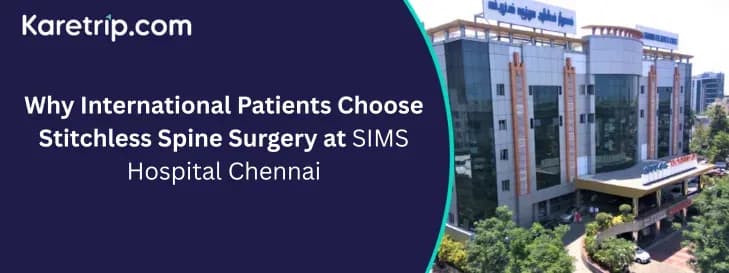

Open spine surgery has traditionally meant large incisions, prolonged muscle retraction, significant blood loss, and a recovery that runs into months. For international patients who must travel home within two to three weeks of surgery, this recovery profile is incompatible with the logistics of treatment abroad. Stitchless spine surgery, the term used for minimally invasive endoscopic and tubular spine procedures that access the spinal column through ports as narrow as 18 millimetres, changes this equation entirely. Smaller access, less tissue disruption, and faster recovery directly address the international patient's most practical constraint. SIMS Hospital, Chennai — ranked among the Top 5 Neurosciences centres in India by Times of India and India Today for seven consecutive years — has built its spine programme around these techniques, making it one of the most credible destinations in South India for international patients seeking minimally invasive spinal care.
What Stitchless Spine Surgery Actually Is
The term "stitchless" spine surgery describes minimally invasive procedures where the skin incision is so small, typically eight to fifteen millimetres, that it often requires no sutures at all, closing instead with a single sterile strip. But the more clinically significant aspect is what happens beneath the skin. Understanding this separates patients who choose this approach for the right reasons from those who choose it based on the term alone.
The Core Technical Distinction from Open Surgery
In conventional open spine surgery, a large midline incision of eight to twelve centimetres is made, and the muscles on either side of the spine are stripped off the vertebrae and held apart with metal retractors for the duration of the procedure. This prolonged retraction causes significant muscle ischaemia, damage, and post-operative pain that accounts for a large proportion of the recovery burden after open surgery.
In stitchless or minimally invasive spine surgery (MISS), the surgeon accesses the spine through one or two small ports. A dilator system is passed through the muscle rather than stripping it, separating the fibres along their natural grain without tearing them from their attachment. A working channel is established, through which endoscopic or tubular instruments and a camera are introduced. The surgeon operates under live imaging on a high-definition monitor, using instruments scaled to the narrow working corridor.
What Changes as a Result
-
Blood loss is typically 30 to 50 percent lower than equivalent open procedures
-
Post-operative pain from muscle damage is significantly reduced
-
Hospital stays shorten from five to seven days in open surgery to one to three days for most MISS procedures
-
Light activities resume within one to two weeks compared to four to six weeks for open surgery
-
Long-haul travel clearance comes sooner, which is the most practically significant advantage for international patients
The Spinal Conditions Treated With Stitchless Techniques at SIMS
SIMS Hospital's spine programme addresses a wide range of conditions using minimally invasive approaches. Not every spinal condition is suitable for stitchless technique complex deformity, multi-level instability, and tumour cases may require open or hybrid approaches but the following are routinely managed using MISS at the Institute of Neurosciences.
Lumbar Disc Prolapse (Herniated Disc)
The most common indication for stitchless spine surgery. A prolapsed disc pressing on a nerve root in the lower back causes sciatica, leg pain, and weakness. Endoscopic or tubular microdiscectomy removes the herniated disc fragment through a port eight to eighteen millimetres in diameter, decompressing the nerve without disrupting the surrounding musculature. Most patients walk the day of surgery and are discharged within 24 to 48 hours.
Cervical Disc Disease and Cervical Spondylotic Myelopathy
Anterior cervical discectomy and fusion (ACDF) for cervical disc prolapse and Cervical Spondylotic Myelopathy compressing the spinal cord are among Dr. Suresh Bapu's specific areas of surgical expertise at SIMS Hospital. These procedures address neck pain, arm numbness, weakness, and in severe cases, progressive spinal cord dysfunction that can cause walking difficulty and hand clumsiness.
Lumbar Spinal Stenosis
Narrowing of the spinal canal in the lumbar spine causes neurogenic claudication — leg heaviness, weakness, and pain with walking that relieves on sitting. Minimally invasive decompression through unilateral or bilateral laminotomy approaches decompresses the neural elements without requiring the larger bone removal of traditional laminectomy, preserving spinal stability and reducing recovery time.
Lumbar Spinal Stabilisation and Fusion
For patients with spondylolisthesis, instability, or recurrent disc disease requiring fusion, minimally invasive lumbar interbody fusion techniques (MISS-TLIF or MISS-PLIF) place interbody cages and percutaneous pedicle screws through small incisions under fluoroscopic or navigation guidance. Hospital stays after minimally invasive fusion are typically two to four days, versus five to seven days for open equivalent procedures.
Spinal Cord Tumours
Minimal access surgery for spinal cord tumours is a specific subspecialty of Dr. Suresh Bapu at the Institute of Neurosciences, SIMS Hospital. Intradural extramedullary tumours including meningiomas and nerve sheath tumours, and intramedullary tumours, are approached through microsurgical corridors that minimise the spinal muscle and bone disruption required for safe tumour access while maintaining the precision needed for complete excision with preserved neurological function.
The Institute of Neurosciences at SIMS Hospital: Why It Matters for Spine Surgery
Before choosing any hospital for minimally invasive spine surgery abroad, international patients need to confirm that the centre has the specific infrastructure, case volume, and specialised expertise that MISS requires. SIMS Hospital's Institute of Neurosciences provides this at a level that supports the full range of spinal conditions.
Rankings and Accreditation
The Institute of Neurosciences at SIMS Hospital has been ranked among the Top 5 Neurosciences centres in India by both Times of India and India Today for seven consecutive years — a sustained institutional recognition that reflects consistent clinical performance rather than a single-year distinction. The hospital's overall accreditation includes NABH certification, ensuring independently verified standards across clinical protocols, infection control, and patient safety.
Volume That Drives Outcomes
The Institute handles 900 or more neurosurgeries annually, including more than 100 endoscopic skull surgeries, 60 to 70 pituitary and sellar surgeries, 60 or more vestibular schwannoma surgeries, and 300 or more intraoperative neurophysiological monitoring (IONM) cases every year. This volume, particularly in endoscopic neurosurgery, is directly relevant to spine surgery quality because the endoscopic skill set developed through skull base and intraventricular procedures translates directly to the precision required in stitchless spinal approaches.
Technology Supporting MISS
The Institute of Neurosciences at SIMS Hospital is equipped with endoscopic spine surgery equipment for minimally invasive spinal procedures, advanced neuronavigation systems for real-time anatomical guidance, intraoperative neurophysiological monitoring for safe surgery near the spinal cord, high-resolution spinal MRI and CT imaging including advanced sequences, and modular neurosurgical operating theatres with dedicated neuro-anaesthesia support.


The Surgeons Leading Spine Care at SIMS
Dr. K. R. Suresh Bapu — Director, Institute of Neurosciences
Dr. K. R. Suresh Bapu brings over 53 years of neurosurgical experience to the SIMS spine programme. His specific spinal surgery expertise includes lumbar microdiscectomy, minimal access spinal surgery, lumbar spinal stabilisation, anterior cervical discectomy, surgery for cervical spondylotic myelopathy, and minimal access surgery for spinal cord tumours. Pioneer of microneurosurgery and endoscopic surgery in Tamil Nadu, he has authored chapters on Spine and Spinal Cord in the Elsevier Clinical Manual of Surgery and authored chapters in Ramamurthi and Tandon's Textbook of Neurosurgery. He received the Lifetime Achievement Award from the Tamil Nadu Association of Neurological Surgeons in 2026 and Doctor of Science Honoris Causa from MAHER University in 2024.
Patients who have traveled from Saudi Arabia, Kenya, South Sudan, and across South Asia specifically to receive care from Dr. Suresh Bapu describe his approach as one that combines technical precision with genuine time investment in understanding and communicating the patient's situation.
Dr. Vijay Sankaran — Joint Director and Senior Consultant
Dr. Vijay Sankaran holds specialised training certification in Minimally Invasive Spinal Surgery from Munich, Germany, bringing an international fellowship-level MISS credential to the SIMS spine programme. He has sharpened his skills at neurological facilities in the UK, including University Hospital Coventry and Warwickshire, Royal Preston Hospital, and Hope Hospital in Manchester. His expertise specifically includes Minimally Invasive Spinal Surgery, spinal stabilisation procedures, artificial disc replacements, endoscopic spine surgery, stereotactic neurosurgery, and neuronavigation systems.
The combination of Dr. Suresh Bapu's foundational microsurgical mastery and Dr. Sankaran's international MISS fellowship training gives the SIMS spine programme dual capability across the full spectrum of minimally invasive spinal procedures.
Recovery and International Patient Planning
The recovery advantage of stitchless spine surgery is most meaningful for international patients when translated into a realistic in-India stay timeline.
| Procedure | Hospital stay | EWalking | In-India stay before flight |
|---|---|---|---|
| Endoscopic discectomy (lumbar) | 1 to 2 days | Day of surgery | 7 to 10 days |
| Anterior cervical discectomy | 2 to 3 days | Day 1 | 10 to 14 days |
| MISS decompression (stenosis) | 2 to 3 days | Day 1 | 10 to 14 days |
| MISS fusion (TLIF/PLIF) | 3 to 5 days | Day 1 to 2 | 14 to 18 days |
| Spinal cord tumour | 4 to 7 days | Guided by surgical findings | 14 to 21 days |
Before leaving SIMS Hospital, each international patient receives a written discharge physiotherapy programme for continuation with a local physiotherapist at home. Karetrip coordinates identification of a local spinal physiotherapist in the patient's home country before discharge.
For patients considering broader neurosurgical care at SIMS Hospital, read: No Open Surgery Required: Advanced Endovascular Options for Brain Aneurysms and How Dr. K. R. Suresh Bapu Approaches Complex Brain Tumor Treatment Cases.
Cost of Stitchless Spine Surgery in India at SIMS
| Procedure | India Cost | USA / UK equivalent |
|---|---|---|
| Endoscopic lumbar discectomy | Rs. 1,20,000 to Rs. 2,00,000 (USD 1,450 to USD 2,400) | USD 15,000 to USD 30,000 |
| Anterior cervical discectomy and fusion | Rs. 1,80,000 to Rs. 3,00,000 (USD 2,200 to USD 3,600) | USD 25,000 to USD 50,000 |
| Minimally invasive lumbar fusion | Rs. 2,50,000 to Rs. 5,00,000 (USD 3,000 to USD 6,000) | USD 30,000 to USD 80,000 |
| Spinal cord tumour resection | Rs. 2,00,000 to Rs. 4,50,000 (USD 2,400 to USD 5,400) | USD 40,000 to USD 100,000 |
All costs include surgeon fee, hospital stay, anaesthesia, and basic consumables. Implant costs (cages, screws, plates) are additional and are itemised in the pre-operative cost estimate.
How Karetrip Connects International Patients to SIMS Hospital Spine Surgery
Karetrip reviews each patient's existing MRI and clinical history before recommending SIMS Hospital and confirming which surgeon is most appropriate for the specific spinal condition. For complex cases including spinal cord tumours, MISS fusion, or cervical myelopathy requiring decompression, Karetrip ensures the case is directed to the surgeon whose specific subspecialty experience matches the clinical complexity.
From pre-travel imaging review and medical visa coordination, through accommodation near SIMS Hospital in Vadapalani, Chennai, discharge physiotherapy documentation, and post-operative telemedicine follow-up with the SIMS spine team, Karetrip manages every element of the international patient journey for stitchless spine surgery in Chennai.
Chat with our Medical care assistant, RUA, for quick guidance and support and take the first step toward getting your spine case reviewed by SIMS Hospital's minimally invasive neurosurgical team.