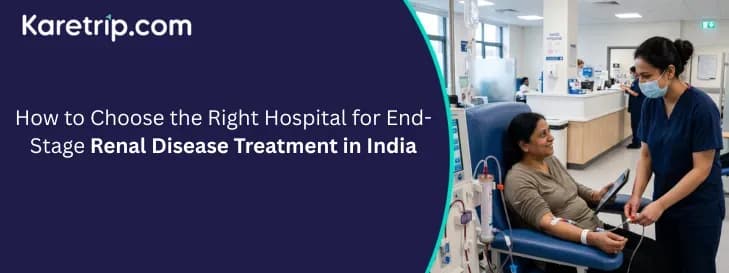

End-stage renal disease is defined precisely: a glomerular filtration rate below 15 mL/min per 1.73 m², at which point the kidneys can no longer sustain life without renal replacement therapy. For international patients reaching this threshold, the decision about where to receive treatment is not just a medical one. It is financial, logistical, and deeply personal. India performs more than 23,000 kidney transplants annually, has among the most experienced nephrology and transplant teams in Asia, and delivers treatment at 60 to 80 percent lower cost than the USA, UK, or UAE. But choosing the right hospital for end-stage renal disease treatment in India requires more than a cost comparison. It requires understanding which criteria actually differentiate programmes, what the three treatment pathways involve, and what questions to ask before committing to a centre. This guide provides that framework.
Understanding ESRD: What Stage You Are At Determines Which Treatment Applies
Before evaluating any hospital, international patients need clarity on which treatment pathway is appropriate for their current kidney function. The answer determines the institutional infrastructure required.
The Three Treatment Pathways
Kidney transplantation is the gold standard for eligible ESRD patients. Renal transplant is the preferred renal replacement therapy as it is most cost-effective and provides better quality of life compared to long-term dialysis. A successful transplant eliminates dialysis dependence, restores closer-to-normal kidney function, and is associated with significantly better survival and quality of life outcomes than maintenance dialysis.
Haemodialysis filters the blood through an external machine three times weekly, each session lasting four hours. It is primarily a bridge measure: for patients awaiting transplant, for patients not eligible for transplant, or for patients being medically optimised before surgery. Without a transplant, most patients in lower-income settings face severe cost and access constraints that make long-term dialysis unsustainable.
Peritoneal dialysis uses the lining of the abdominal cavity as a filter, with dialysate fluid exchanged either manually (CAPD) or automatically overnight (APD). It allows greater patient independence and home-based treatment but requires careful patient selection, training, and infection risk management.
The Treatment Decision Matrix
| Patient profile | Recommended pathway |
|---|---|
| Eligible for transplant with living donor available | Proceed to pre-transplant evaluation immediately |
| Eligible for transplant, no donor yet | Start dialysis as bridge; pursue deceased donor waitlist or donor evaluation |
| Not eligible for transplant (cardiovascular, age, or cancer contraindications) | Long-term dialysis programme with supportive care |
| Stage 4 CKD approaching ESRD | Medical optimisation including SGLT2 inhibitors, AV fistula creation, pre-emptive transplant evaluation |
The 2025 KDIGO guidelines and clinical updates confirm that SGLT2 inhibitors (originally developed for diabetes) now significantly delay progression to ESRD in both diabetic and non-diabetic CKD, making timely Stage 4 intervention an important consideration before reaching the threshold for renal replacement therapy.
The Six Criteria That Differentiate ESRD Hospitals in India
Choosing correctly among India's transplant centres requires applying specific criteria rather than relying on general hospital rankings or brand recognition.
Criterion 1: Transplant Volume and Programme Maturity
Annual kidney transplant volume is the most reliable single indicator of institutional capability. A centre performing fewer than 30 to 50 transplants per year has a qualitatively different experience base from one performing 150 or more annually. High-volume programmes develop the perioperative protocols, complication management pathways, and multidisciplinary coordination that produce consistent outcomes.
Ask specifically: how many kidney transplants were performed in the past 12 months, and what proportion were living donor versus deceased donor cases?
Criterion 2: Living Donor Programme Capability
Living related donor transplants constitute 70 percent of all transplants in India, with spouses accounting for approximately 20 percent of donors from within families. A robust living donor programme requires a dedicated donor evaluation pathway separate from recipient care, laparoscopic donor nephrectomy capability to minimise donor morbidity, and a legal and ethical framework compliant with India's Transplantation of Human Organs Act.
Confirm whether the centre offers minimally invasive (laparoscopic) donor nephrectomy, which reduces donor recovery time from six to eight weeks to three to four weeks — a significant consideration for a family member traveling with the recipient.
Criterion 3: Nephrology and Pre-Transplant Medical Optimisation
Transplant surgery is only one component of ESRD care. The nephrology team managing the patient before, during, and after transplant is equally important. A strong nephrology department provides complete pre-transplant cardiovascular, immunological, and metabolic evaluation, manages dialysis during the pre-transplant waiting period, and handles post-transplant immunosuppression optimisation.
The first three to six months after transplant carry the highest risk of rejection and infection. Post-transplant nephrology follow-up quality directly determines long-term graft survival.
Criterion 4: Crossmatch and Tissue Typing Laboratory
The compatibility between donor and recipient at the HLA (human leukocyte antigen) level and complement-dependent cytotoxicity crossmatch directly determines rejection risk. A centre performing transplants without an on-site NABL-accredited tissue typing and crossmatch laboratory is operating with a significant logistical limitation. Confirm that the hospital has its own accredited transplant immunology laboratory rather than outsourcing this critical step.
Criterion 5: Multidisciplinary Team Depth
End-stage renal disease treatment in India at a world-class level requires more than a nephrologist and a transplant surgeon. The complete team should include:
-
Transplant nephrologist
-
Transplant surgeon with dedicated renal transplant fellowship training
-
Transplant anaesthesiologist experienced in ESRD physiology
-
Infectious disease specialist for post-transplant infection management
-
Transplant pharmacist for immunosuppression protocol management
-
Transplant coordinator managing international patient logistics
-
Dietitian experienced in post-transplant nutritional management
Ask whether these roles exist as dedicated transplant team members or are borrowed from other specialties on an as-needed basis.
Criterion 6: Accreditation and Regulatory Compliance
NABH accreditation is the minimum verifiable quality standard. JCI accreditation signals that the hospital meets an internationally recognised benchmark applied by an independent external body. NABL accreditation of the pathology and tissue typing laboratories verifies that laboratory testing meets comparable standards.
Equally important is the centre's compliance with India's Transplantation of Human Organs and Tissues Act (THOTA) and the authorisation of its transplant committee by the appropriate state health authority. All legitimate transplant centres in India must be registered and authorised under this framework, which also governs the permissible relationship between living donors and recipients.


What International Patients Must Prepare Before Arrival
The pre-arrival preparation stage directly determines the efficiency of the evaluation process in India and the time from arrival to surgery.
Documents to Send in Advance
-
Complete nephrology records: GFR trend, creatinine trajectory, proteinuria data, and current medications
-
Most recent renal ultrasound and CT renal angiography (for transplant planning)
-
Echocardiogram and ECG (cardiovascular clearance is required before listing)
-
Blood group, virology screen (HIV, HBsAg, HCV, CMV status)
-
Living donor's basic medical profile if a donor has been identified
Send these to Karetrip for pre-assessment by the receiving nephrology and transplant team before the medical visa application is made.
Legal Documentation for Living Donor Transplants
India's THOTA requires that living donors be genetically related to the recipient, or demonstrate a documented personal relationship approved by the State Authorization Committee (SAC). Spousal donors are acceptable. The SAC evaluation involves documentation, an interview process, and independent committee review. This process takes several weeks and must be planned into the travel timeline. Karetrip assists in preparing the SAC documentation package and coordinating the committee review schedule.
Post-Transplant: The Most Overlooked Planning Stage
More than 70 percent of complications after kidney transplant occur in the first three to six months, during the highest-intensity immunosuppression period. International patients returning home must plan for this period with the same rigour as they plan for surgery.
Before leaving India, ensure:
-
A nephrologist in the home country has been identified and has received the discharge documentation
-
The immunosuppression protocol is written with generic drug names alongside brand names, as brand availability varies by country
-
Laboratory monitoring targets (tacrolimus trough levels, creatinine, urine protein) are documented with the testing intervals
-
Contact details for the India transplant team are available for telemedicine follow-up
-
Fever management protocol (38°C threshold for same-day medical assessment) is understood by both the patient and accompanying family members
For detailed guidance on recognising and managing post-transplant complications after returning home, read: Traveling Home After Surgery? Managing Kidney Transplant Infection Symptoms Safely
Cost of End-Stage Renal Disease Treatment in India
| Treatment pathway | India cost | USA / UK equivalent |
|---|---|---|
| Pre-transplant evaluation (full) | Rs. 50,000 to Rs. 1,00,000 (USD 600 to USD 1,200) | USD 5,000 to USD 15,000 |
| Living donor kidney transplant | Rs. 8,00,000 to Rs. 15,00,000 (USD 9,600 to USD 18,000) | USD 100,000 to USD 300,000 |
| Deceased donor kidney transplant | Rs. 10,00,000 to Rs. 18,00,000 (USD 12,000 to USD 21,600) | USD 150,000 to USD 400,000 |
| Haemodialysis (per session) | Rs. 800 to Rs. 2,500 (USD 10 to USD 30) | USD 300 to USD 500 per session |
| 1-year post-transplant medication | Rs. 80,000 to Rs. 2,00,000 (USD 960 to USD 2,400) | USD 10,000 to USD 30,000 |
How Karetrip Connects International ESRD Patients to the Right Hospital
Choosing a hospital for end-stage renal disease treatment in India involves verifying transplant volume, donor programme capability, laboratory accreditation, and regulatory compliance none of which are reliably confirmed from a hospital's marketing materials alone. Karetrip reviews each patient's nephrology records and donor situation before recommending a centre, verifying that the proposed hospital has the specific infrastructure the patient's case requires.
For patients with a living donor, Karetrip coordinates the SAC documentation preparation and committee scheduling. For patients without a donor, Karetrip assists with understanding the deceased donor waitlist process and helps plan the dialysis bridge period while listing is pursued. From pre-travel record review and medical visa support, through accommodation near the transplant hospital, discharge documentation preparation, and post-transplant follow-up coordination, Karetrip manages every element of the ESRD treatment journey in India.
Chat with our Medical care assistant, RUA, for quick guidance and support and take the first step toward getting your case assessed by the right end-stage renal disease specialist in India.
Medical Disclaimer
This article is for informational purposes only and is not medical advice. End-Stage Renal Disease (ESRD) requires precise clinical management. Your specific treatment pathway—whether a kidney transplant or dialysis—and your individual recovery milestones depend entirely on your current GFR, tissue typing, cardiovascular clearance, and overall health markers. Always consult a certified nephrologist or transplant specialist before making cross-border medical travel plans.