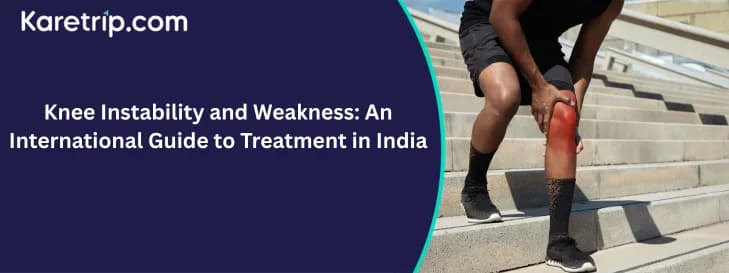

Knee instability and weakness rarely announce themselves dramatically. More often, they arrive as a gradual loss of confidence in the joint: a knee that buckles on stairs, gives way during a change of direction, or simply feels unreliable during activities that used to be effortless. For some patients, the cause is an old sports injury that was never fully treated. For others, it is years of cumulative ligament laxity, cartilage loss, or muscle imbalance that has progressively worsened over time.
What Is Causing Your Knee Instability?
The structural integrity of your knee depends on an interconnected network of ligaments, muscles, tendons, and cartilage. When any part of this system fails or wears down, the mechanical balance of the entire limb is compromised.
Evaluating your knee's stability requires mapping out the exact components that have sustained damage:
Ligament Failure: The Primary Structural Roadblock
Ligaments act as the main passive restraints of the joint. When they tear or stretch, the knee loses its natural baseline constraints:
-
Anterior Cruciate Ligament (ACL): This is the primary knee stabilizer, preventing forward displacement of the tibia. Tearing it causes immediate buckling, swelling, and chronic instability during sudden rotational or cutting movements.
-
Posterior Cruciate Ligament (PCL): Positioned behind the ACL, it prevents the tibia from slipping backward. PCL tears usually stem from high-impact trauma, like a dashboard collision, and often present as deep joint pain.
-
Medial Collateral Ligament (MCL): Running along the inner knee, the MCL opposes extreme inward (valgus) forces. While isolated tears frequently heal with bracing, complex combined tears require surgical intervention.
-
Lateral Collateral Ligament (LCL): Situated on the outer knee, it limits excessive outward (varus) pressures. LCL damage is less common but highly disruptive when paired with broader joint trauma.
Quadriceps Deficits and Muscle Atrophy
Muscles serve as the dynamic, active stabilizers of your knee. When pain or injury causes you to protect your leg, clinically significant muscle wasting (atrophy) can appear in the quadriceps within just one week of disuse.
This creates a dangerous loop. Weak quadriceps cannot properly control the kneecap or stabilize the joint during extensions, making the knee highly prone to giving way even during low-impact activities like walking or standing up.
Patellar Instability and Tracking Issues
Patellar instability occurs when the kneecap partially slips (subluxates) or fully dislocates from its structural groove on the femur. This issue causes sharp anterior knee pain and a sudden feeling that the joint is collapsing.
It is frequently driven by damage to the Medial Patellofemoral Ligament (MPFL) or an inherited misalignment like a high Q-angle. Left untreated, recurrent dislocations occur in up to 72% of cases, progressively wearing down the cartilage behind the kneecap.
The Long-Term Risk: Progression to Osteoarthritis
Untreated knee instability does not remain static. When ligaments are loose or muscles are severely imbalanced, the knee is forced to move through abnormal, uneven loading patterns.
This chronic friction quickly accelerates the wear and tear of your articular cartilage. Over a few short years, this mechanical instability can transform a treatable soft-tissue injury into severe, bone-on-bone knee osteoarthritis, eventually requiring highly invasive total joint reconstructions.
The Essential Diagnostic Pathway
Before establishing an international care protocol, your surgical team must isolate the mechanical source of the weakness. This is achieved through a multi-layered, objective clinical workup:
Specialized Provocation Testing
Experienced orthopedic surgeons utilize specific, manual stress tests to check for laxity:
-
The Lachman & Anterior Drawer Tests: Used to verify ACL integrity.
-
The Posterior Drawer & Sag Tests: Utilized to evaluate PCL stability.
-
Pivot Shift Assessments: Performed to determine complex rotational instability.
High-Resolution 3T MRI Scanning
While physical exams expose joint laxity, a high-resolution 3T MRI is crucial to visualize internal tissue continuity. It maps out ligament tear percentages, meniscal tears, hidden bone bruising patterns, and the exact state of your remaining cartilage.
Weight-Bearing Digital X-Rays
Standing, weight-bearing X-rays are vital to evaluate your joint space. This imaging tells the clinical team whether your instability can be solved via soft-tissue arthroscopy, or if bone-on-bone degeneration has progressed far enough to warrant a partial or total joint replacement.


Advanced Treatment Paths Available in India
From early-stage non-surgical stabilization to complex joint revisions, India's leading NABH-accredited hospitals provide the entire global spectrum of orthopedic care:
Conservative Neuromuscular Training
For mild laxity or early degenerative weakness, structured physical therapy is the first line of defense. Advanced protocols move past basic stretching to prioritize targeted quadriceps strengthening and balance perturbation training. This focused regimen re-educates the body's natural reflex systems to stabilize the joint dynamically.
Arthroscopic Ligament Reconstruction (ACL / PCL / MPFL)
Active or athletic patients dealing with clear structural instability are ideal candidates for minimally invasive arthroscopy. Utilizing advanced autografts (sourced from your hamstring or patellar tendons) and bioabsorbable fixation systems, surgeons rebuild your stabilizing tracks through small incisions:
-
ACL/PCL Reconstruction: Re-anchors structural joint tracks to restore total rotation control.
-
MPFL Reconstruction: Specifically targets and secures the kneecap to permanently prevent lateral dislocations.
High Tibial Osteotomy (HTO) with Ligament Repair
When knee instability is paired with a severe bow-legged (varus) misalignment, a standalone ligament graft faces excessive stress and is highly likely to fail. To fix this, surgeons perform a High Tibial Osteotomy (HTO) alongside the ligament repair.
By strategically adjusting the shinbone angle, the surgeon shifts the body's mechanical weight away from the damaged side, protecting the new ligament graft and significantly delaying the need for joint replacement.
Precision Knee Replacement Surgery
For advanced osteoarthritis where the cartilage has completely degraded, total or partial knee replacement surgery becomes the definitive solution. Indian tertiary care hubs specialize in Robotic-Assisted Total Knee Arthroplasty.
Robotic-Assisted Total Knee Arthroplasty.
Using specialized CT-driven 3D modeling and real-time haptic feedback, robotic platforms position premium implants with sub-millimeter accuracy. This precise approach ensures optimal ligament balancing, highly natural joint movement, and excellent long-term implant survival.
Comparing Treatment Logistics & Financial Profiles
| Treatment Intervention | In-Country Stay Required | Success / Precision Rate | Average Cost Structure in India |
|---|---|---|---|
| Arthroscopic ACL / PCL Repair | 10 to 14 Days | 90% – 95% Success | USD 1,800 to USD 4,200 |
| Combined HTO + Ligament Surgery | 14 to 18 Days | Marked Functional Gain | USD 3,500 to USD 5,500 |
| Robotic Total Knee Replacement | 14 to 21 Days | Over 95% Precision | Starts at USD 3,900 |
Why International Patients Choose India for Orthopedic Care
For active individuals and athletes dealing with progressive joint instability, traveling to India provides immediate access to world-class musculoskeletal care. The combination of elite surgical expertise, advanced robotic systems, and accelerated medical scheduling allows patients to rebuild their mobility without facing long public health waiting lists.
International families consistently select India's top-tier orthopedic networks due to several key advantages:
Significant Financial Accessibility
A complete orthopedic treatment package in India costs 60% to 80% less than equivalent surgical procedures in the US, UK, or UAE. This immense cost difference allows international families to easily afford the premium implants, advanced robotic planning, and extended post-operative rehabilitation required for a complete recovery.
High-Volume Orthopedic Specialists
Top-tier Indian orthopedic hospitals house dedicated sports medicine and joint reconstruction sub-specialists who manage exceptional case volumes annually. Clinical data proves that high surgeon volume directly matches lower complication rates and highly predictable functional outcomes.
Immediate Surgical Mobilization
Unlike public health systems globally that subject patients to debilitating six to twenty-four month waitlists, private hospitals in India clear international cases quickly. Patients can typically transition from their initial diagnostic consultation to the operating room within one to two weeks of landing.
Complete Care Coordination with Karetrip
Karetrip Resolving chronic knee weakness across borders requires flawless organization. takes the logistical burden off your family, allowing you to focus entirely on regaining your active lifestyle.
Your dedicated Karetrip medical coordinator completely manages your recovery blueprint:
-
Pre-Travel Case Triage: Gathering your hometown MRIs and standing X-rays for remote review by senior Indian surgeons to secure a confirmed provisional diagnosis before you travel.
-
Emergency Visa Acceleration: Fast-tracking official hospital-stamped e-Medical Visa invitation letters within a rapid 24 to 72-hour turnaround.
-
Sanctuary Travel Housing: Selecting highly sanitized, ground-level, or elevator-accessible serviced apartments close to your clinic to keep your recovery stress-free.
-
The Split-Care Rehabilitation Handshake: Delivering a comprehensive, written, milestone-based physical therapy protocol directly to your hometown therapist to ensure flawless recovery continuity once you fly home.
Unsure if your knee weakness can be corrected via a muscle-sparing arthroscopic repair or if it requires a robotic joint reconstruction?
Chat with our medical care assistant, RUA, for clear, immediate guidance, and take your first step toward walking with total confidence again.
Medical Disclaimer
This article is compiled for international healthcare awareness and general educational reference regarding advanced orthopedic interventions. It does not replace a personalized clinical consultation, physical examination, or official diagnosis by a licensed orthopedic surgeon or sports medicine specialist. Individual treatment pathways, recovery timelines, and surgical outcomes vary significantly based on baseline joint degeneration, muscular health, and co-existing medical conditions. Always consult a qualified specialist before making cross-border medical travel decisions or modifying an active joint management plan.