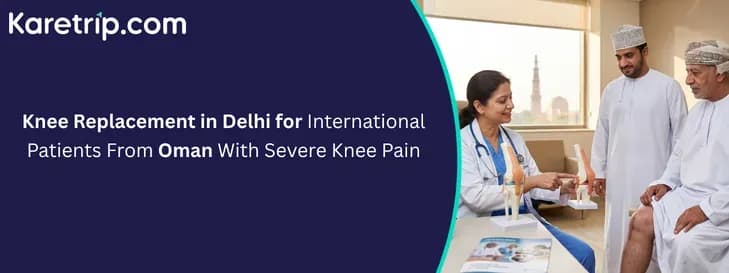

Severe knee pain that has reached the point where walking to the kitchen requires planning, where every step on stairs demands a pause, and where the nights bring as much discomfort as the days is a quality-of-life crisis that deserves a definitive response. For patients in Oman who have exhausted physiotherapy, injections, and pain management, knee replacement surgery is that response. Delhi has emerged as one of the world's most capable knee replacement destinations for international patients, combining NABH and JCI-accredited hospitals, some of India's highest-volume joint replacement surgeons, robotic surgical technology equal to what is available in the UK or USA, and costs that are 60 to 80 percent lower than comparable private care in Oman, the UAE, or Europe.
This guide gives Oman patients everything they need to plan knee replacement in Delhi, the hospitals worth considering, the surgeons who lead them, the costs, the travel from Oman, and what Karetrip coordinates so the entire journey is managed rather than improvised.
Why Oman Patients Specifically Choose Delhi for Knee Replacement
For patients traveling from Oman, Delhi offers a rare combination of clinical excellence, geographic accessibility, and remarkable cost efficiency. With world-class orthopedic centers, internationally trained joint replacement surgeons, and specialized Arabic patient services, the capital city ensures a smooth medical travel experience from arrival through recovery.
Direct Flight Access That Makes the Journey Manageable
For Oman patients, Delhi is significantly closer and better connected than most other major medical tourism destinations. Oman Air operates direct flights from Muscat to Indira Gandhi International Airport, Delhi, with a flight duration of approximately three hours and forty-five minutes. Daily departures mean the travel can be timed around the surgery schedule without compromise. Air Arabia and IndiGo offer connecting options via Dubai and Sharjah. The total journey time from Muscat to Delhi rarely exceeds five to six hours, making it considerably more accessible than traveling to Germany, Thailand, or the UK for the same procedure.
Cost Difference That Makes Delhi the Rational Choice
Knee replacement surgery in private hospitals in Oman or the UAE for a patient without full insurance coverage can cost USD 10,000 to USD 20,000 or more for a standard procedure. The same operation in Delhi at a NABH-accredited hospital using internationally certified Zimmer Biomet, Stryker, or DePuy implants costs USD 3,000 to USD 6,600 for a single knee and USD 5,000 to USD 11,000 for bilateral replacement a saving that, for a couple where both partners need surgery, can represent over USD 30,000 in total. This is not a cost reduction achieved by reducing quality. It is a structural difference in the healthcare economics of India versus the Gulf, using the same implants and equivalent accreditation standards.
The cost of robotic knee replacement surgery in Delhi for international patients is between USD 4,000 and USD 6,100 for unilateral knee replacement and USD 6,000 to USD 10,700 for bilateral knee replacement. Total stay in Delhi will be 14 to 18 days.
Delhi's Orthopaedic Infrastructure
Delhi is one of India's top destinations for knee replacement due to its high-quality hospitals and skilled surgeons. The average cost ranges from Rs. 1,60,000 to Rs. 3,80,000 for a single knee. Many hospitals offer robotic knee replacement, which may cost on the higher side but ensures better precision and faster recovery.
Delhi hosts some of India's highest-volume joint replacement surgeons, operating in facilities that run three to four knee replacements per day per operating theatre. This volume produces the surgical fluency, institutional protocol development, and complication management experience that directly translates into better outcomes for complex cases.
Understanding Severe Knee Pain: When Replacement Is the Right Decision
Oman patients presenting for knee replacement consultation in Delhi most commonly have severe osteoarthritis, but several other conditions also drive the decision toward joint replacement.
Conditions That Lead to Knee Replacement
-
Severe osteoarthritis: The most common indication. When bone-on-bone contact has developed in one or more knee compartments, when the joint space has narrowed to the point of deformity on weight-bearing X-ray, and when conservative treatment including physiotherapy, weight management, and injection therapy has ceased to provide meaningful relief, knee replacement is the appropriate surgical response.
-
Rheumatoid arthritis with joint destruction: Inflammatory arthritis can destroy knee cartilage faster than osteoarthritis. When joint destruction is advanced and systemic disease management alone cannot restore function, replacement is indicated alongside continued rheumatological treatment.
-
Post-traumatic arthritis: A previous knee injury including fracture around the joint, ligament injury with secondary cartilage damage, or prior knee surgery with subsequent joint deterioration can accelerate arthritis. Post-traumatic arthritis often affects younger patients and is a specific indication for knee replacement when the joint damage is severe.
-
Avascular necrosis of the femoral condyle: Localised bone death in the knee produces rapid joint destruction. When the necrotic area is large or has collapsed, knee replacement is the appropriate definitive treatment.
The Clinical Signals That Mean Replacement Is Warranted
Patients from Oman asking whether they are ready for knee replacement should seek consultation when:
-
Knee pain significantly limits walking to less than thirty minutes before stopping is required
-
Stair climbing produces severe pain on most occasions
-
Night pain disturbs sleep regularly
-
Corticosteroid or hyaluronic acid injections have ceased to provide useful relief
-
Weight-bearing X-ray shows significant joint space narrowing or bone-on-bone contact
-
The joint has become visibly deformed, with varus (bow-legged) or valgus (knock-kneed) alignment
Knee Replacement Options in Delhi for Oman Patients
Delhi has established itself as a premier destination for joint replacement, offering patients from Oman access to internationally trained orthopedic surgeons and state-of-the-art surgical technology. Whether addressing localized wear or advanced multi-compartment joint degeneration, hospitals provide customized surgical approaches designed to restore painless mobility and ensure a safe, supported recovery before your flight home.
Total Knee Replacement (TKR)
Total knee replacement is the definitive treatment for severe knee arthritis affecting all three compartments. All three bone surfaces of the knee joint are resurfaced with precision-fitted metal and polyethylene components that eliminate bone-on-bone contact and restore smooth, pain-free movement. TKR achieves greater than 90 percent patient satisfaction at ten years when performed by experienced high-volume surgeons using appropriately selected implants.
Hospital stay is typically three to five days. Patients walk with support on the first post-operative day. Most Oman patients are cleared for the return flight within fourteen to sixteen days of surgery.
Partial Knee Replacement (Unicompartmental)
When arthritis is confined to one compartment of the knee, partial replacement preserves the healthy compartments and produces faster recovery than total replacement. Partial knee replacement is appropriate for medial compartment osteoarthritis in patients who are not significantly overweight and have no inflammatory arthritis. Recovery is faster than TKR, with most patients achieving independent walking within the first week.
Robotic-Assisted Knee Replacement
Robotic-assisted procedures allow for greater precision and can lead to shorter recovery times and better results. Advantages of robotic knee surgery include lower long-term costs, better patient outcomes, and higher patient satisfaction.
Robotic knee replacement in Delhi uses CT-based pre-operative 3D planning and intraoperative haptic guidance to position implant components with sub-millimetre accuracy. For Oman patients who will not have immediate access to the surgical team after returning home, a precisely positioned implant requires less compensatory management during rehabilitation and performs more predictably over the long term. The Mako robotic system is available at multiple Delhi hospitals and is the most widely used robotic platform in joint replacement.
Bilateral Knee Replacement
For patients from Oman with severe arthritis in both knees, bilateral knee replacement in a single surgical episode saves one full travel visit to India. Both knees are replaced simultaneously under a single anaesthetic. The physiological demands are higher than a single knee replacement, making careful patient selection important. Patients under 65 with no significant cardiac or pulmonary disease are generally good candidates for simultaneous bilateral replacement.


Best Hospitals for Knee Replacement in Delhi for International Patients From Oman
Delhi NCR hosts several internationally accredited healthcare institutions renowned for high-volume joint replacement programs and advanced robotic surgical suites. For patients traveling from Oman, these premier hospitals combine advanced orthopedic technologies with dedicated international wings offering Arabic language assistance, seamless visa documentation, and end-to-end travel coordination.
Indraprastha Apollo Hospital, Delhi
Indraprastha Apollo Hospital, is one of the top hospitals, equipped with the Da Vinci Robotic Surgery System, BrainLab Navigation, and high-resolution imaging including PET-MR and 3 Tesla MRI to ensure exceptionally precise and minimally invasive treatments.
Indraprastha Apollo is JCI and NABH-accredited and serves thousands of international patients annually. Its orthopaedic and joint replacement programme covers total knee replacement, robotic knee replacement with the Mako system, partial replacement, and complex revision surgery. Apollo's international patient services department provides Arabic translation support, visa documentation assistance, and accommodation coordination specifically relevant for Oman patients.
Medanta, The Medicity, Gurugram (Delhi NCR)
Medanta is consistently ranked among India's top orthopaedic hospitals and is thirty minutes from Delhi's international airport. Its Institute of Musculoskeletal Disorders covers primary and revision knee replacement, bilateral procedures, and robotic surgery. Dr. Ashok Rajgopal and Dr. Ramneek Mahajan are among the top surgeons at Medanta, with the hospital recognised as a leader in minimally invasive knee replacements.
Fortis Hospital, Delhi
Fortis hospitals across Delhi NCR offer NABH-accredited knee replacement with robotic surgical platforms, internationally certified implants, and established international patient programmes. Fortis has a strong track record with patients from the Middle East and the Gulf region, with Arabic-speaking patient coordination available at major Delhi Fortis campuses.
Max Hospital, Saket
Max Hospital Saket is renowned for personalised joint replacement plans and is considered best for high-risk patients. Max Super Speciality Hospital holds JCI and NABH accreditation and offers a comprehensive joint replacement programme with robotic and navigated surgery options alongside conventional techniques.
Sant Parmanand Hospital, Delhi
At Sant Parmanand Hospital, the CUVIS robot uses infrared imaging for surgical precision. This reduces human error and customises implant placement to each patient's anatomy. Sant Parmanand is specifically noted for its technology investment in knee replacement and is a strong option for patients specifically seeking robotic surgery.
What Oman Patients Need to Prepare Before Traveling to Delhi
Investigations to Complete in Oman Before Departure
The most productive Delhi consultation begins with complete pre-operative records submitted before the flight is booked. Complete the following in Muscat before travel:
Imaging:
-
Weight-bearing X-rays of both knees: AP (front-on), lateral (side), and full-length lower limb alignment views on a single film
-
MRI of the affected knee if ligament or cartilage damage is suspected alongside arthritis
Blood tests:
-
Full blood count, CRP, ESR
-
Renal function (creatinine, eGFR) and liver function
-
HbA1c and fasting blood glucose
-
Blood group and Rh factor
-
Coagulation screen (PT, aPTT)
Cardiac:
-
ECG
-
Echocardiogram if over 60 or if any cardiac symptoms are present
Send these to Karetrip before booking the flight. The Delhi orthopaedic team reviews the records, confirms whether total, partial, or robotic replacement is most appropriate, and provides a cost estimate and surgery date before any travel is committed to.
Medical Visa for India from Oman
Oman passport holders can apply for an Indian e-Medical Visa online through the Indian government's visa portal (indianvisaonline.gov.in). The e-Medical Visa requires:
-
A letter from the treating Indian hospital confirming the procedure and expected duration
-
Hospital reference number
-
Passport-quality photograph
-
Valid Omani passport
Processing typically takes three to five working days. The hospital invitation letter required for the visa application is provided by Karetrip as part of the pre-travel coordination.
The In-Delhi Journey: What to Expect
-
On arrival: Airport pickup to hospital or accommodation is arranged by Karetrip. Admission to the hospital is coordinated with the orthopaedic team.
-
Pre-operative assessment (days one to two): Repeat blood tests, pre-anaesthetic review, surgical planning consultation with the orthopaedic surgeon, and confirmation of implant selection.
-
Surgery (day two to three): Total knee replacement takes one to two hours. Hospital stay following surgery is three to five days. Physiotherapy begins the day after surgery.
-
Post-operative recovery in Delhi (days six to fourteen): Accommodation within ten to fifteen minutes of the hospital. Daily physiotherapy sessions. Wound check and suture removal at ten to fourteen days. Surgical clearance for long-haul travel.
-
Return flight to Muscat: Most patients are cleared for the return flight on day fourteen to sixteen. Compression stockings and prescribed anticoagulation are mandatory for the flight. An aisle seat for regular movement should be booked.
-
At home in Oman: The written physiotherapy programme provided before discharge is continued with a local physiotherapist in Muscat. Karetrip coordinates telemedicine follow-up with the Delhi surgical team at three, six, and twelve weeks after surgery.
Cost Summary: Knee Replacement in Delhi for Oman Patients
| Procedure | Delhi cost | Oman/UAE equivalent |
|---|---|---|
| Total knee replacement (single) | Rs. 2,00,000 to Rs. 5,50,000 (USD 2,400 to USD 6,600) | USD 10,000 to USD 20,000 |
| Robotic knee replacement (single) | Rs. 2,50,000 to Rs. 6,50,000 (USD 3,000 to USD 7,800) | USD 15,000 to USD 25,000 |
| Bilateral knee replacement | Rs. 4,00,000 to Rs. 10,00,000 (USD 4,800 to USD 12,000) | USD 20,000 to USD 40,000 |
| Partial knee replacement | Rs. 1,80,000 to Rs. 3,50,000 (USD 2,160 to USD 4,200) | USD 8,000 to USD 15,000 |
How Karetrip Connects Oman Patients to Knee Replacement in Delhi
Karetrip reviews each patient's X-rays, blood results, and surgical history before recommending the right Delhi hospital and surgeon for the specific presentation. From the hospital invitation letter for the visa application, through airport transfers, accommodation near the hospital, in-hospital coordination, written physiotherapy programme for Muscat continuation, and telemedicine follow-up, Karetrip manages every element of the knee replacement journey in Delhi for patients from Oman.
Chat with our Medical care assistant, RUA, for quick guidance and support and take the first step toward knee replacement in Delhi planned specifically for your situation.
Medical Disclaimer
This article is for informational purposes only and does not constitute medical advice. Knee conditions require evaluation by a qualified orthopaedic surgeon. Consult a specialist before making any treatment decision.