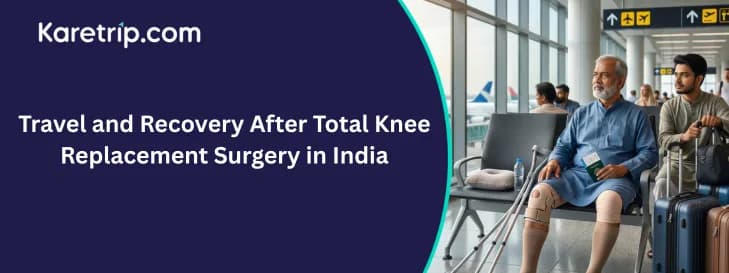

Severe osteoarthritis of the knee presents a cruel paradox: the very joint you need to navigate the world has become the source of your greatest agony. When local medical infrastructure cannot provide advanced orthopedic solutions, you are faced with a daunting reality, you must travel thousands of miles for a Total Knee Replacement (TKR) when simply walking to your kitchen is a painful struggle.
For patients from Bangladesh, the Middle East, and Africa, India is the ultimate destination for joint replacement. India’s elite JCI-accredited hospitals utilize the world’s most advanced robotic surgical platforms (like Mako and NAVIO), ensuring sub-millimeter precision, minimal tissue damage, and rapid mobilization.
However, the surgery itself only accounts for 30% of your success. The remaining 70% relies entirely on your post-operative recovery and travel logistics.
How do you safely board an international flight with a new metal joint? How do you prevent life-threatening blood clots during travel? Most importantly, where do you safely recover and undergo physical therapy in a foreign country before you are cleared to fly home?
1. The Pre-Flight Strategy: Protecting the Patient
The logistical planning begins weeks before you cross the border. Traveling with severe joint degeneration requires aggressive risk management.
-
Mandatory Wheelchair Assistance: Do not attempt to "tough it out" at the airport. karetrip coordinates end-to-end VIP wheelchair assistance. From the moment you arrive at your home airport (e.g., Dhaka or Muscat) to the moment our private vehicle picks you up on the tarmac in India, you must minimize weight-bearing on the degraded joint.
-
The DVT Threat: Deep Vein Thrombosis (blood clots in the legs) is the greatest risk in orthopedic travel. Hours spent sitting in a pressurized airplane cabin drastically increase this risk. Your local doctor and your Indian surgeon will collaborate to prescribe specific compression stockings and, in some cases, pre-flight blood thinners to ensure you land safely in India.
-
The Medical Visa (VIL): You cannot delay your surgery due to bureaucratic red tape. By pre-booking your surgical suite based on your local X-rays, karetrip instantly generates the official Visa Invitation Letter (VIL), fast-tracking your Indian Medical Visa.
2. The Hospital Phase: Fast-Track Mobilization
Gone are the days when a knee replacement meant two weeks in a hospital bed. In 2026, the elite Indian orthopedic protocol is "Fast-Track Recovery."
-
Day 1: Immediate Weight-Bearing: If your surgeon utilizes a Robotic-Assisted TKR, the trauma to your surrounding muscles and ligaments is minimal. Astonishingly, the hospital’s physiotherapy team will have you standing up and taking your first steps with a walker on the very same day of your surgery, or the morning after.
-
The 5 to 7-Day Stay: You will remain in the hospital's dedicated orthopedic ward for roughly a week. During this time, the focus is on pain management (using advanced nerve blocks rather than heavy, groggy narcotics), monitoring the surgical incision, and beginning basic range-of-motion exercises.


3. The Outpatient Gap: Why Commercial Hotels Fail Orthopedic Patients
When you are discharged from the Indian hospital on Day 7, you are not flying home. Airline medical regulations and orthopedic safety protocols strictly dictate that you must wait 14 to 21 days post-surgery before taking an international flight, primarily to monitor for infections and prevent fatal blood clots.
This mandatory 2 to 3-week stay in India is where traditional medical tourism breaks down. A commercial hotel is an active physical hazard for a patient with a week-old knee replacement.
-
The Fall Hazard: Standard hotels have slippery bathroom tiles, bathtubs you cannot step over, and beds that are often too high or too low, making getting up incredibly painful and dangerous.
-
The Diet Problem: Post-operative swelling is your biggest enemy. To combat it, you need an anti-inflammatory, low-sodium diet. Hotel room service is notoriously high in salt, which will cause your new knee to swell painfully, stalling your physical therapy.
4. The karetrip Sanctuary: Engineered for Orthopedic Recovery
We refuse to let logistical oversights jeopardize your mobility. karetrip actively engineers a protective, orthopedic-safe ecosystem for your mandatory outpatient recovery phase.
Accessible, Ground-Floor/Elevator Housing: We exclusively transition our TKR patients into premium serviced apartments that are 100% accessible. There are no stairs to navigate. The bathrooms feature walk-in showers with grab bars and non-slip surfaces, drastically reducing the risk of a catastrophic post-op fall.
-
The Private Kitchen Advantage: Our apartments feature fully equipped private kitchens. This allows your accompanying family to purchase fresh, local groceries and cook familiar, low-sodium, highly nutritious meals. This dietary control is a clinical necessity for reducing joint inflammation and speeding up soft tissue healing.
-
At-Home Physiotherapy: You should not be fighting Indian city traffic with a healing knee. karetrip coordinates with certified orthopedic physiotherapists who visit your private apartment daily. They guide you through the crucial bending and strengthening exercises right in your living room, ensuring you hit your mobility milestones safely.
-
Sanitized Ground Transport: When it is time to return to the hospital for your staple removal and final X-rays, we provide spacious, low-entry private vehicles, ensuring you can get in and out of the car without bending the knee past its comfortable limit.
5. The Journey Home: Clearance and Telemedicine
Before you are allowed to head to the airport, your Indian surgeon must issue a formal "Fit to Fly" certificate.
-
The Airport Security Reality: Yes, your new cobalt-chromium or titanium knee will set off airport metal detectors. karetrip ensures you are provided with an official Implant Identification Card from the hospital, signed by your surgeon, to smoothly bypass security checkpoints.
-
In-Flight Protocols: For the flight home, you will wear prescribed graduated compression stockings. We advise booking aisle seats with extra legroom (or Business Class if the budget permits) so you can extend the leg and perform ankle-pump exercises every 30 minutes to maintain blood flow.
-
The Digital Handover: Your care does not end when you land in Dhaka, Muscat, or Nairobi. karetrip facilitates a seamless telemedicine handover. You will continue your advanced physical therapy at home, while we arrange periodic remote video consultations with your Indian surgeon to monitor your long-term gait and joint stability.
Conclusion: Seamless Travel, Unrestricted Mobility
A Total Knee Replacement is a modern medical miracle, capable of giving you back a life free from chronic pain. However, accessing this miracle in India requires moving your body across international borders when it is at its most vulnerable.
By understanding the strict timelines, the massive risks of blood clots, and the absolute necessity of accessible housing, you can navigate this journey with confidence.
By partnering with karetrip, you eliminate the physical and logistical friction of medical travel. We secure your fast-track visas, provide the VIP ground transport, arrange your at-home daily physiotherapy, and, most importantly, build a safe, accessible, kitchen-equipped sanctuary for your recovery. We carry the weight of the logistics, so your new knee only has to carry you.
Are you tired of letting knee pain dictate your life?
Do not let the fear of travel stop you from healing. Chat with Rua, our dedicated patient care coordinator. Securely upload your knee X-rays today, and let karetrip orchestrate a safe, seamless pathway to your robotic joint replacement in India.
Medical Disclaimer
The logistical guidelines, timelines, and travel advice provided in this article are intended strictly for educational and planning purposes and do not substitute for professional medical counsel. Total Knee Replacement (TKR) is a major surgical intervention carrying inherent risks, including blood clots, infection, and implant failure. Recovery speeds vary drastically based on individual patient health, age, and adherence to physiotherapy. karetrip serves as an independent medical facilitation platform, organizing secure data transfers, priority specialist consultations, and accessible travel logistics exclusively with verified JCI/NABH-accredited institutions, but does not provide direct medical treatment. Always consult directly with a board-certified Orthopedic Surgeon regarding your clinical viability for surgery and air travel.