
When heart treatment costs start to vary this widely, choosing where to go becomes just as important as the treatment itself. Many patients explore medical travel to balance affordability with quality care, especially for procedures like balloon angioplasty.
Some destinations are known for cost-effective, high-volume expertise, while others focus on premium hospital experience and comfort. This is where comparing options becomes essential. For example, Patients can save 50–90% on medical treatments in India compared to higher-priced destinations in Asia.
In this guide, you will explore how balloon angioplasty Thailand vs India differs in cost, care quality, and overall treatment journey, helping you choose the right destination with clarity and confidence.
What Is Balloon Angioplasty?
Balloon angioplasty, also called coronary angioplasty or PCI (percutaneous coronary intervention), is a minimally invasive procedure used to open a narrowed or blocked coronary artery and improve blood flow to the heart.
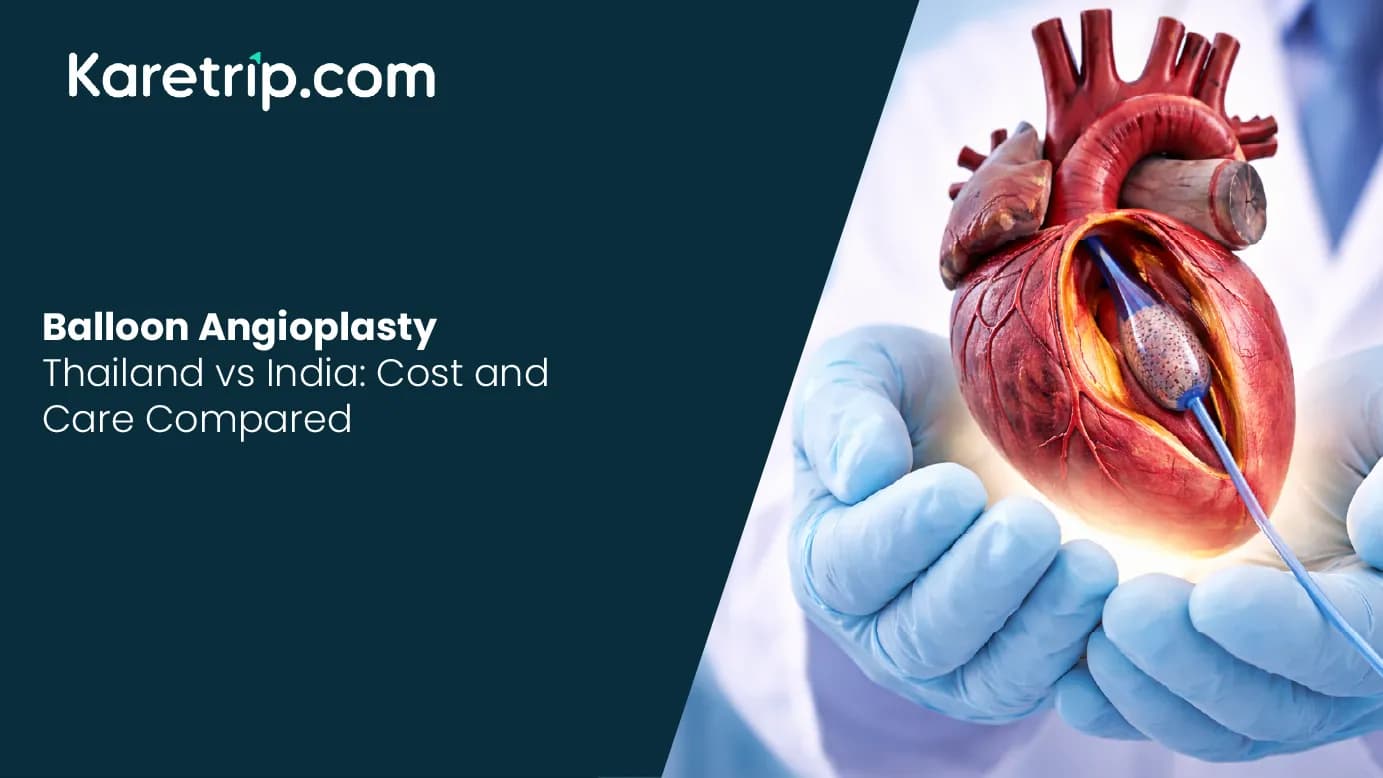
During the procedure, a cardiologist guides a thin catheter with a small balloon to the blockage, inflates the balloon to widen the artery, and may place a stent to help keep the artery open afterwards.
Doctors usually recommend balloon angioplasty when plaque buildup in the coronary arteries starts reducing blood flow to the heart. This can happen in people with coronary artery disease, recurring chest pain (angina), or during or after a heart attack, when quick restoration of blood flow is critical.
This procedure is usually done in a catheter lab, not a traditional operating theatre, and may take around 30 minutes to 2 hours, depending on how complex the blockage is.
Key things you should know:
- It is used to treat blocked or narrowed heart arteries.
- It is generally considered minimally invasive, but it is still an important cardiac procedure.
- A stent is often placed during the same procedure to help keep the artery open.
- Recovery is usually faster than major heart surgery, though follow-up care still matters.
Balloon angioplasty is not just one standard treatment with the same experience everywhere. The procedure itself may be similar, but the cost, type of stent used, hospital stay, recovery support, doctor expertise, and overall patient experience can vary significantly between countries.
That is exactly why a comparison like balloon angioplasty Thailand vs India matters, because you are not only choosing a procedure, but also choosing the healthcare system around it.
Now that you know what the procedure involves, the next step is to see how the two destinations compare where it matters most.
Balloon Angioplasty in Thailand vs India: Key Differences at a Glance
When patients compare Thailand and India for balloon angioplasty, they are usually weighing the same three things: cost, clinical quality, and overall treatment experience. Both countries have strong cardiac centres, experienced interventional cardiologists, and hospitals that serve international patients. The difference is usually not whether the procedure is available, but how it is delivered, what it costs, and what kind of support surrounds it.
Here’s a quick comparison of Thailand vs India across all factors:
| Factor | India | Thailand |
|---|---|---|
| Overall positioning | Better known for cost-effective cardiac treatment at scale | Better known for premium hospital experience and international patient comfort |
| Hospital ecosystem | Large network of cardiac hospitals across multiple cities | Strong private hospital network with a high concentration of international hospitals |
| Accreditation | 63 JCI-accredited hospitals + 1700 NABH network ensuring quality benchmarks | Large number of JCI-accredited private hospitals |
| Quality standards | National Accreditation Board for Hospitals & Healthcare Providers sets 600+ quality parameters for hospitals | JCI standards followed widely in private hospitals; internationally benchmarked accreditation system |
| Popular cardiac treatment cities | Chennai, Delhi NCR, Mumbai, Hyderabad, Bengaluru, known for high-volume cardiac centres | Bangkok is the primary hub; most international cardiac hospitals are concentrated there |
| Doctor expertise & volume | Large centres perform very high volumes of cardiac procedures, improving clinical experience. | Internationally trained doctors (US/UK exposure), but generally lower procedural volume compared to India’s largest centres |
| Technology & infrastructure | Advanced technologies like IVUS, OCT, hybrid cath labs, robotic-assisted procedures widely available in tertiary hospitals | Similar advanced technologies available, especially in top private hospitals with strong investment in imported equipment |
| Healthcare system structure | Mix of public + private hospitals with strong tertiary care ecosystem | Dominated by private hospitals catering to international patients |
| International patient services | Available in top hospitals; includes visa, interpreters, and care coordination but varies by provider | Highly structured systems with dedicated international desks, multilingual coordinators, concierge services |
| Likely fit | Patients prioritising affordability, access to specialists, and complex cardiac procedures | Patients prioritising comfort, premium experience, and streamlined care journey |
Also Read: Planning Your Heart Care? Know the Angioplasty Cost in Kolkata
Once you understand the clinical differences, the focus naturally shifts to the financial side, what the treatment actually costs and what is included in that cost.
Balloon Angioplasty Cost in Thailand vs India: Detailed Cost Comparison
For most patients, the cost gap between Thailand and India is shaped less by the procedure itself and more by the healthcare system behind it. India benefits from tighter price controls on major consumables such as coronary stents, while Thailand’s medical travel market is more private-hospital-led and more dependent on imported high-tech devices.
That usually makes India the more cost-efficient option, while Thailand tends to cost more, especially in premium private hospitals.
A quick pricing benchmark makes that difference clearer:
| Feature | India | Thailand |
|---|---|---|
| Average Cost | $1,500 – $4,500 (INR 78K - 92K) | $8,000 – $14,000 (THB 256,800 - 449,400 |
| Best Price Factors | Lower overheads, top-tier private hospitals, high volume of cases. | High-end facilities (JCI-accredited), premium medical tourism service. |
| Major Costs | Stents, hospital tier, surgeon skill. | Number of stents, hospital, surgeon fees. |
Important points:
- In India, official CGHS package rates provide a useful benchmark for angioplasty pricing, even though private hospital bills can be higher.
- In Thailand, cost varies sharply by hospital type. A PubMed-indexed study found PCI costs were much higher in private hospitals than in government hospitals.
This pricing gap becomes easier to understand when you look at what keeps treatment costs lower in India.
What Makes Balloon Angioplasty More Affordable in India?
India’s affordability in balloon angioplasty comes from a combination of government pricing controls, standardised treatment benchmarks, and a high-volume healthcare system.
Unlike many countries where pricing varies widely, India has mechanisms that keep key procedure elements more predictable and controlled.
Here’s what drives the lower cost:
- Regulated stent pricing: Government caps on coronary stents reduce one of the biggest cost drivers.
- Standardised package rates: CGHS benchmarks create a pricing reference across hospitals.
- High patient volume: Large cardiac centres perform procedures at scale, improving cost efficiency.
- Lower operational costs: Infrastructure and staffing costs are comparatively lower than private-heavy systems.
Once cost is clear, the next layer of comparison is the standard of care behind it.
Quality of Care and Cardiac Expertise in India vs Thailand
Both India and Thailand offer advanced cardiac treatment, but they are known for slightly different strengths. India stands out for its scale, specialist depth, and large accredited hospital base, while Thailand is known for its private-hospital quality systems and highly structured international patient care.
Key differences in care quality:
- Accreditation standards: India follows a dual system with NABH (national) and JCI (international) accreditations, while Thailand has a high concentration of JCI-accredited private hospitals, especially in Bangkok.
- Doctor expertise and case volume: India’s major cardiac centres handle high volumes of angioplasty procedures, which strengthens clinical experience. Thailand’s specialists are often internationally trained but may work in comparatively lower-volume private settings.
- Hospital infrastructure and technology: Both countries offer advanced technologies such as cath labs, IVUS, OCT, and minimally invasive cardiac tools, so there is no major gap in technical capability.
- International patient support: Thailand stands out for structured coordination, including multilingual teams, concierge services, and smoother patient handling. India offers similar services in top hospitals, but the level of support can vary.
- Care delivery model: India focuses more on clinical efficiency and specialist access, while Thailand focuses on comfort, coordination, and patient experience.
Also Read: Verified List of JCI Accredited Hospitals in India with Details
After cost and care, the practical side of travel can influence the decision just as much.
Medical Travel Logistics: India vs Thailand for Balloon Angioplasty
For international patients, treatment planning does not end with the hospital quote. Visa process, flight access, city choice, and recovery stay all affect how smooth the journey feels. This is where India and Thailand differ in practical ways. India has a clearly defined e-Medical Visa system, while Thailand’s process is usually handled through its official e-Visa route or embassy channels depending on nationality and travel purpose.
Some major travel and stay differences are:
1. Visa pathway
India has dedicated e-Medical and e-Medical Attendant visa categories listed on the official government visa portal, which makes the medical travel route more clearly defined. Thailand’s official e-Visa platform provides visa-category and document guidance, but eligibility and visa type depend more on your nationality and case details.
2. Processing and planning
India’s government states that visa processing generally requires a minimum of three working days, excluding special cases. Thailand’s e-Visa system is fully online, but the exact visa route and timeline can vary, so patients usually need to verify requirements through the official e-Visa portal or Thai mission before booking treatment.
3. Treatment city options
India gives you more cardiac treatment hubs across cities such as Delhi NCR, Mumbai, Chennai, Hyderabad, and Bengaluru, which can help with hospital choice and price comparison. Thailand’s international cardiac care is more concentrated in Bangkok, which can make coordination simpler but gives you fewer city-level options. This city-distribution point is an inference based on India’s broad accredited hospital base and Thailand’s private-hospital-led international care model.
4. Stay and recovery environment
Thailand often offers a more structured recovery experience in private hospitals, with international desks, multilingual coordination, and concierge-style support. India also offers these services in leading hospitals, but the experience can vary more by hospital and city.
India usually works well for patients who want a clear medical visa route and wider hospital choice, while Thailand often suits patients who prefer a more centralised, premium private-hospital travel experience.
Once the logistics are clear, the final decision comes down to which destination fits your priorities better.
Which Destination Fits You Better: India or Thailand?
There is no single best option for every patient. In balloon angioplasty Thailand vs India, the right choice depends on what matters most to you, lower cost, wider hospital choice, smoother coordination, or a more premium hospital stay.
Choose India if you:
- Want more affordable treatment with stronger cost efficiency across a larger hospital network. India has over 1,700 NABH-accredited hospitals and 63 JCI-accredited institutions, which gives patients a wider pool of quality-assured options.
- Prefer more hospital and city choices for comparing doctors, costs, and treatment plans.
- Value specialist depth and high-volume care, especially if you want access to large tertiary and multispecialty centres.
Choose Thailand if you:
- Prioritise patient comfort and smoother coordination throughout the treatment journey. In Thailand many private hospitals have international liaison departments with multilingual staff.
- Prefer a premium private-hospital environment with more standardised non-clinical support, such as concierge-style services and a more centralised patient journey. Thailand has 62 JCI-accredited hospitals, 52 of them private, which reflects how strongly its medical travel system is built around private care.
- Want a more streamlined single-city treatment setup, especially in Bangkok, where a large share of internationally focused hospitals are concentrated.
Once you know why India may be the better fit, the next step is turning that choice into a treatment plan you can actually act on.
Plan Your Balloon Angioplasty in India with Karetrip
Choosing India for balloon angioplasty is only the first part of the journey. The more important part is making sure you choose the right hospital, the right cardiologist, and the right treatment plan without getting lost in medical, travel, and cost-related decisions.
This is where Karetrip adds practical value. Instead of leaving you to compare hospitals, estimate expenses, arrange visas, and coordinate recovery on your own, Karetrip helps you manage the full treatment journey in one place.
Here’ s how Karetrip supports your treatment journey:
- Hospital matching based on your case: Get connected to the right hospitals and cardiologists based on your reports, condition, and budget.
- Structured pre-travel treatment planning: Share reports, receive expert opinions, and understand your treatment plan, stay, and costs before you travel.
- Clear cost estimation support: Get a structured breakdown of hospital, travel, and recovery costs with Karetrip’s planning assistance Rua.
- Medical visa and travel coordination: Assistance with visa, flights, accommodation, airport pickup, and local transport, all in one place.
- Language and on-ground support: Access interpreters and local assistance for smoother communication and stay.
- Post-treatment continuity: Get help with follow-ups, recovery planning, and remote consultations after returning home.
Thus, instead of navigating hospitals, costs, and travel on your own, get a clear, structured treatment plan tailored to your case.
Share your medical reports with Karetrip today and receive personalised hospital options, cost estimates, and end-to-end support, so you can move forward with clarity and confidence.