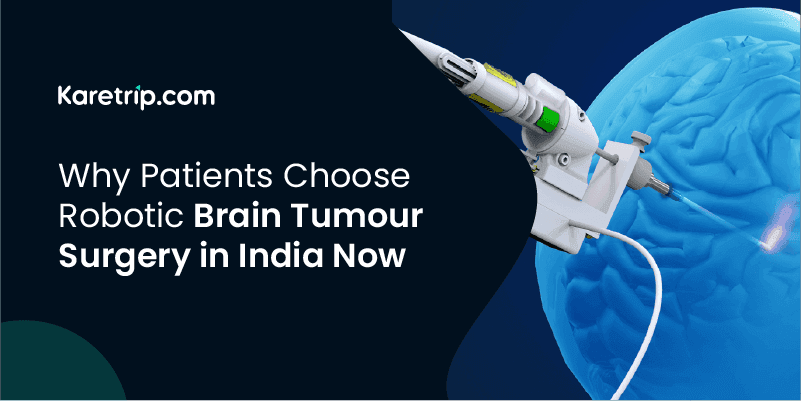

Hearing the words “brain tumour” can shake anyone to the core, and the thought of surgery only adds to the anxiety. However, robotic brain tumour surgery, which uses advanced robotic arms and real‑time imaging, achieves millimetre precision and can reduce complications and recovery time compared with traditional methods. India has emerged as a leading destination for this care, offering world‑class hospitals, highly trained neurosurgeons, and up to 60–90% lower costs than many Western countries. In this blog, we explain how robotic surgery works, its benefits, who qualifies, costs, and why India is a trusted choice.
What Happens in Robotic Brain Tumour Surgery?
Robotic brain tumour surgery is an advanced form of minimally invasive neurosurgery where surgeons use computer-guided robotic systems to assist in removing or treating brain tumours with extremely high precision. The robot does not perform the surgery independently, it is fully controlled by a trained neurosurgeon at all times.
What makes this approach different is the level of accuracy and control it offers. These systems combine high-definition 3D imaging, real-time navigation, and robotic arms that can execute movements far more precisely than the human hand alone.
This is especially important in brain surgery, where even a tiny deviation can affect critical functions like speech, vision, or movement. Some of the key features that define robotic brain tumour surgery are:
- Image-guided accuracy: Uses MRI/CT-based navigation to locate tumours with pinpoint precision
- Enhanced stability: Robotic arms eliminate natural hand tremors
- Access to complex areas: Helps surgeons reach deep or sensitive parts of the brain safely
- Tissue preservation: Minimises damage to surrounding healthy brain tissue
Now that the concept is clear, let’s look at the specific types of brain tumours where robotic surgery is most effective.
Types of Brain Tumours Treated in India Using h Robotics Surgery?
Robotic brain tumour surgery is particularly useful for tumours that require extreme precision, especially when they are located near critical brain structures or deep within the brain. It is not limited to one type but is carefully selected based on tumour location, size, and complexity.
They are also useful when access is difficult with conventional methods or when highly accurate targeting is required for biopsy. This approach helps reduce the risk of neurological complications after surgery.
Here’s a quick overview of common brain tumours treated using robotic assistance:
| Tumour Type | Why Robotic Surgery Is Preferred |
|---|---|
| Gliomas (low and high grade) | Often located within brain tissue; robotics helps preserve surrounding healthy cells |
| Meningiomas | Usually near the brain surface but close to vital nerves or blood vessels |
| Pituitary Adenomas | Located at the skull base; robotics supports precise, minimally invasive access |
| Metastatic Brain Tumours | Multiple or deep lesions benefit from targeted, accurate removal |
| Acoustic Neuromas | Close to hearing and facial nerves, requiring delicate handling |
| Deep-Seated Lesions | Tumours in areas like the thalamus or brainstem where precision is critical |
Knowing which tumours can be treated is important, but understanding how the surgery is actually performed can help you feel more confident about the process.
How Robotic Brain Tumour Surgery Is Performed?
Robotic brain tumour surgery combines advanced imaging, computer-guided navigation, and surgeon-controlled robotic systems to perform highly precise procedures inside the brain. Every step is carefully planned and executed to minimise risk and protect critical brain functions.
The stages of robotic brain tumour surgery are:
1. Pre-Surgical Brain Mapping and Planning
Before the surgery begins, your brain is carefully mapped using advanced imaging to understand the exact tumour location and its relation to critical functions. This step is crucial because even a small error can affect movement, speech, or vision.
To plan the safest and most precise surgical approach, doctors focus on:
- Creating a 3D model of the brain and tumour using MRI and CT scans.
- Identifying critical functional areas through fMRI (speech, motor, vision).
- Mapping neural pathways using tractography to avoid damage.
- Defining a safe entry path that minimises impact on healthy tissue.
2. Real-Time Image-Guided Navigation
During the procedure, surgeons rely on a navigation system that works like a real-time tracking tool, helping them stay aligned with the pre-planned surgical path. This ensures accuracy even in complex or deep areas.
This precision is maintained through:
- Continuous tracking of surgical instruments against the 3D brain map.
- Sub-millimetre accuracy in locating the tumour.
- Real-time adjustments to account for minor brain shifts during surgery.
- Enhanced visual guidance for deep or hard-to-reach tumours.
3. Robotic-Assisted Precision Execution
At this stage, robotic systems assist the surgeon in performing highly controlled movements that are difficult to achieve manually. The technology enhances stability and allows safer access to sensitive brain regions.
This level of control is achieved by:
- Converting surgeon inputs into tremor-free, micro-level movements.
- Enabling access through narrow and delicate surgical pathways.
- Reducing unnecessary handling of surrounding brain tissue.
- Supporting procedures involving deep-seated or skull-base tumours.
4. Continuous Monitoring and Intraoperative Feedback
Throughout the surgery, your brain activity and surgical progress are continuously monitored to ensure safety and effectiveness. This allows the surgeon to make immediate, informed decisions during tumour removal.
This ongoing monitoring includes:
- Use of intraoperative imaging (MRI or ultrasound) for live updates.
- Neurophysiological monitoring to track brain function in real time.
- Immediate adjustments to avoid damage to critical areas.
- Ensuring maximum tumour removal while preserving function.
Knowing the advantages is helpful, but when you compare robotic surgery directly with traditional methods, the real differences in precision, safety, and recovery become much clearer.
Robotic vs Traditional Brain Tumour Surgery: What Truly Sets Them Apart
Both robotic and traditional brain tumour surgeries aim to safely remove or treat tumours. However, the way they approach precision, access, and safety differs significantly, especially in complex or high-risk cases involving delicate brain structures.
Here’s a clear, side-by-side comparison to help you understand what really changes:
| Parameter | Robotic Brain Tumour Surgery | Traditional Brain Surgery |
|---|---|---|
| Surgical Precision | Uses robotic assistance for sub-millimetre accuracy and controlled micro-movements | Relies entirely on surgeon’s hand stability and experience |
| Access to Tumour | Enables minimally invasive, targeted pathways, even in deep or narrow regions | Often requires larger openings for visibility and access |
| Impact on Healthy Tissue | Highly focused approach helps preserve surrounding brain tissue | Greater manipulation of nearby tissue may be required |
| Risk of Complications | Lower risk due to real-time navigation and monitoring systems | Relatively higher in complex or deep-seated tumours |
| Intraoperative Guidance | Combines 3D imaging, navigation systems, and robotics for continuous accuracy | Limited to imaging and manual adjustments during surgery |
| Recovery Time | Typically shorter hospital stay and faster recovery | Recovery may take longer depending on surgical extent |
| Suitability | Ideal for complex, deep-seated, or high-risk tumours | Suitable for a wider range, including less complex cases |
Once you understand the benefits, the next step is knowing where you can access this level of precision with the right expertise, safety standards, and cost advantage.
Why Is India a Preferred Destination for robotic brain tumour surgery?
India has emerged as a leading destination for robotic brain tumour surgery, not just because of affordability, but due to a strong combination of advanced neurosurgical infrastructure, globally trained specialists, and high procedural volumes. For international patients, this translates into quality care without long waiting times or excessive costs.
Here’s what specifically makes India a preferred choice:
- Highly Experienced Neurosurgeons: Many specialists are trained in the US, UK, or Europe and have extensive experience handling complex and high-risk brain tumours.
- Access to Advanced Robotic and Navigation Systems: Leading hospitals are equipped with technologies like neuronavigation (brain GPS), intraoperative MRI, and robotic-assisted platforms, enabling high-precision surgeries.
- Significantly Lower Treatment Costs: Robotic brain tumour surgery in India can cost 60–80% less compared to countries like the US or UK, without compromising clinical standards.
- Internationally Accredited Hospitals: Many centres are JCI or NABH accredited, ensuring strict adherence to global safety and quality protocols.
- Minimal Waiting Time; Unlike many Western countries, patients can typically schedule surgery within days, which is critical for progressive brain tumours.
Also Read: Understanding the Latest Advancements in Non-Invasive Brain Tumour Treatments
After understanding the benefits and outcomes, it’s only natural to ask, what will this treatment actually cost in India, and what does that cost really include?
Cost of Robotic Brain Tumour Surgery in India
Robotic brain tumour surgery in India is considerably more affordable than in many Western countries, while still offering access to advanced technology and experienced neurosurgeons. On average, the cost ranges between INR 3.5L to INR 10L (approximately $4K to $12K).
This usually includes pre-surgical tests, surgeon fees, robotic technology usage, hospital stay, and medications, making it a comprehensive and value-driven treatment option.
To better understand how India compares globally in terms of cost, here’s a quick overview:
| Country | Cost in USD | Cost in INR (approx.) |
|---|---|---|
| India | USD 4K-12K | INR 3.5L – 10L |
| USA | USD 50K – 100K+ | INR 41L - 82L |
| UK | USD 40K – 80K | INR 33L - 66L |
| Germany | USD 35K – 70K | INR 29L – 58L |
Note: The final cost may vary depending on tumour complexity, surgeon expertise, hospital choice, and length of stay. For international patients, additional savings often come from lower diagnostic, accommodation, and overall living expenses in India.
Also Read: How Much Does Brain Tumour Surgery Cost in India?
As you explore where to undergo treatment, choosing the right hospital becomes just as important as the technology itself.
Top 5 Hospitals in India for Robotic Brain Tumour Surgery
India offers a strong mix of advanced neurosurgical technology and highly experienced specialists, making it easier for international patients to access precise and safe brain tumour treatment.
Here are some of the most trusted hospitals known for robotic-assisted and image-guided neurosurgery:
1. Fortis Memorial Research Institute
A leading quaternary care centre known for handling complex brain tumour cases with high precision. The hospital uses advanced neuronavigation and intraoperative imaging to improve tumour targeting while protecting critical brain areas. It is especially preferred for high-risk and deep-seated tumours.
2. Medanta – The Medicity
Home to one of India’s largest neurosciences departments, Medanta is equipped with advanced navigation systems and precision surgical tools. Its multidisciplinary team approach ensures better planning and outcomes, particularly for complex or recurrent brain tumours.
3. Artemis Hospital
A JCI-accredited hospital offering advanced robotic and radiation technologies like CyberKnife. It is known for minimally invasive brain tumour procedures, supported by high-end imaging and structured international patient care services.
4. Indraprastha Apollo Hospital
One of the pioneers of advanced neurosurgery in India, Apollo provides technologies such as Gamma Knife and intraoperative MRI. The hospital is well-known for treating complex tumours near sensitive brain regions with a high degree of accuracy.
5. Yashoda Hospitals
Recognised for its use of intraoperative MRI and real-time imaging during brain tumour surgery. Yashoda combines precision-guided techniques with experienced neurosurgeons, making it a strong option for patients seeking advanced yet cost-effective care.
Once you’ve identified the right hospital, the next step is planning your treatment journey in a way that is smooth, safe, and well-coordinated from start to finish.
Plan Your Robotic Brain Tumour Surgery in India with Karetrip
Planning treatment abroad can feel complex, but with the right support, it becomes a clear and organised process. Karetrip helps you manage every step with precision, so you can focus on treatment and recovery.
Here’s how your journey typically unfolds:
- Share Your Medical Reports: Upload your MRI scans and reports to receive a precise expert evaluation and confirm the most suitable surgical approach.
- Get a Personalised Plan & Cost Estimate: Receive a customised treatment plan with hospital options, surgical approach, and a transparent cost breakdown.
- Choose the Right Hospital: Get matched with the most suitable hospital and neurosurgeon based on your condition, technology needs, and budget.
- Travel & Pre-Surgery Support: Karetrip assists with medical visa, travel arrangements, and pre-surgery coordination to avoid delays.
- Surgery & Recovery Assistance: Receive on-ground support during hospitalisation, including coordination, guidance, and post-surgery care assistance.
- Follow-Up After You Return Home: Continue care with online consultations, recovery monitoring, and ongoing support through Rua.
Ready to take the next step? Share your reports with Rua and get a personalised treatment plan and cost estimate from Karetrip today.
Final Thoughts
Robotic brain tumour surgery in India offers a powerful combination of precision, advanced technology, and cost advantage, making it a preferred choice for international patients. With access to experienced neurosurgeons, modern surgical systems, and structured care pathways, you can achieve safe outcomes without the high financial burden seen in many Western countries.
Connect with Rua on Karetrip to explore the right hospital, expert, and treatment path specific to your case.